Thursday, September 28, 2006

Time to enlist??

As I was signing off last night, after putting up my post about the Mozilla guy, open-source marketing and the pop-up stopping Firefox browser (which I almost always use), I found a surprise under my window: an Army recruiting pop-up!

I almost never see a pop-up, unless I happen to click on the wrong button by mistake. So my first thought was, "How did that get here?" And I took a screenshot (left).

Then I wondered, "What site did I cruise tonight that might have harbored an Army pop-up?" Maybe it was when I read Sidney Blumenthal's "At War, In Denial" on Salon.com. You think?

I mean, I know the Army is getting desperate for recruits, but if they're now targeting 50-plus, out-of-shape female academics who sometimes need a cane to walk...well, they're more desperate than I thought. Especially since I think the war in Iraq is a lost cause, and our commander in chief has gone off the deep end.

Think I should reqest an Army Info Pack?

Wednesday, September 27, 2006

Make like Mozilla...with viral marketing

If you want make like Mozilla, it helps to have a compelling product that's a good value and solves an annoying problem. It also helps if you trust your users, and arm them with the tools they need to spread the word.

That's what Asa Dotzler says, and he should know. As community coordinator of the Spread Firefox project for Mozilla, he's been one of the innovators of open source marketing.

Dotzler, who spoke Sept. 21 in Palo Alto, Calif., at the Third Thursday meet-up, first got involved with Mozilla as a volunteer beta tester. His avocation turned into a career.

Compelling? Well, Firefox offered something the dominant browser, Internet Explorer, didn't -- a solution to those annoying pop-ups.

A good value? Well, free is a pretty good.

The result? A lot of people tried it, liked it, and told their friends. (Hey, that's how I heard about it. Thank you, Steve Greene!)

The next step, Dotzler said, is to help your users spread the word.

For example, when positive comments started appearing in blogs about Firefox, Dotzler asked one well-known blogger who'd said he liked the new browser to put a "get Firefox" button on his blog. The blogger agreed. So he asked more bloggers -- about 100 of them -- and within 24 hours, 85 of them had put up a button.

It was working, but it took a lot of time and effort to identify and contact all those bloggers.So they asked Firefox users to help automate the process. Several volunteered and worked together to make it happen.

"You need to put it in their hands," he said. "Let them be that engine."

It was also a Firefox user who suggested asking fellow users to raise money for an ad to celebrate shipping Firefox 1.0. They gave themselves a month to raise the needed funds, but they got twice as much as they needed in just two weeks. So they decided on a two-page ad in the New York Times, with one page listing the names of everyone who'd helped to get Firefox off the ground, and one offering user testimonials about what makes Firefox special.

Dotzler said the ad initially created just a small uptick in Firefox users...but, as the ad itself became news, those numbers kept growing.

Recently, when Mozilla put out a call to Firefox users to create some 30-second ads, it got 280 submissions...about five or six times as many as they'd expected. Of those, Dotzler said, about 60 were broadcast quality and five were truly "top-notch." He hopes Mozilla will be the first open-source company to run a user-made ad.

The best way to go into a volunteer project like this is without any preconceptions, Dotzler said. Otherwise, you tend to end up with token attempts at user involvement...like the recent Chevy "make your own ad" web promotion. Those kinds of efforts can backfire, he said, like the Chevy promotion did when some folks found ways to create negative Chevy ads out of the promo clips Chevy provided.

A better example, Dotzler said, is CurrentTV, which requires advertisers to let viewers to participate in creating advertisements. The result, he said, has been ads that offer an authenticity missing in most commercials today.

It's really hard to fake authenticity, he added, so why not let your users take the lead?

P.S. For college students looking for internships, Dotzler noted, "You don't have to ask Mozilla for an internship...you can just come in and do it, and get credit for what you've done." Dotzler said he writes lots of letters of recommendation for college students who've worked on Firefox.

Couric confessions

I have a confession to make. I haven't watched Katie Couric yet in her new gig on the CBS Evening News.

I'm feminist enough to think it's a milestone, but jaded enough to think that winning the top seat in a dying medium isn't much of a prize.

Of course, I've got plenty of excuses for not watching. I isten to the news on NPR while I'm driving...I usually check the news online when I check my email...I get the NYT delivered to my email box...and I have afternoon classes this semester, so I'm not usually home when the evening news comes on (whenever that is...it's been so long since I actually watched a national newscast that I'm not sure).

But the truth is that I just find it hard to get too worked up over Couric being on the CBS Evening News. Wish I could, but it's just not there. Maybe I'm just not a big fan of happy talk.

Now if she'd decided to leave the networks behind and move over to the web instead...well, that would be another story.

Sunday, September 17, 2006

Registered to vote?

If you're eliglible to vote but haven't yet registered, you still have time...October 23 is the deadline to register for the Nov. 7 election. But please don't wait until the last minute -- register now!

To get you started, here are links to the League of Women Voters' Smart Voter web pages for Santa Clara County and San Mateo County, as well as the Secretary of State's voter registration web page. The LWV's Smart Voter pages include county-by-county information on the fall electoral contests.
If you'd like to get your hands on a voter registration form, just ask me -- I'll be bringing voter registration forms to campus over the next two weeks, as part of a voter registration effort sponsored by my church.
Pondering those propositions?

If you're becoming bewildered by the burgeoning barrage of political ads -- all of which seem to be trashing one state proposition or another -- you'll appreciate the LWV's helpful directory of the 14 state propositions that will appear on the November ballot.

The LWV's short nonpartisan proposition summaries are a good way to get past the hype and name-calling and find out what those propositions are really about...and make up your own mind on how to vote. Links to the full text of each proposition are included.

Thursday, September 14, 2006

Scoble answers JMC students' questions

Questions? Yes, we had plenty of questions for Blogger Robert Scoble, of Scobelizer fame, when he spoke at JMC Tuesday evening. Scoble came to the SJSU campus to speak to Journalism 163 students. Here's a sampling:

Are news outlets mainly going to be aggregators in the future, or are they still going to create content?

Some of both, Scoble said, pointing out that Newsweek broke the HP story, not a blogger. It's also hard for a blogger to cover Iraq, he added. Big city newspapers and news brands will survive.

However, that doesn't mean he thinks newsprint will survive.

News brands will stick around, but you're not likely to read it on paper, Scoble said. Newprint is expensive, and so is home delivery, so he thinks the paper side of the news business is going away.

"I do not read paper," Scoble said. "I don't subscribe to it, I don't read it. Because I can get tomorrow's news today (online)."

"I doubt that any one in this class is going to get hired to work on a newspaper," he added, though they may get hired by a newspaper's online side to work for the newspaper brand.

Is MS Office dead? (A loaded question for the former Microsoft evangelist!)

"I don't use Word anymore," Scoble said. "For me, Word is dead. I moved my usage pattern from Word onto Wordpress."

Does he worry about privacy, now that he's become so well known?

"Privacy? I take the Madonna approach," Scoble said. "I'm going to exploit my privacy before anyone else does...everything's out there."

However, he said privacy is going to be a problem, particularly with the MySpace crowd as they come of age to enter the job market.

"Something in society is tilting," Scoble said, adding that in his last four interviews, his interviewers had printed out some of his blog posts and had questions about why he'd said what he said. One of them had about 20 pages of his blog printed out and highlighted.

What that means, Scoble said, is that bloggers and the MySpace generation have got to start thinking in terms of "what's this going to look like in 20 years." On the other hand, he noted, for a lot of media employers, if they can't find you in Google, they're not interested in hiring you.

"Instructors here used to work with students to get lots of clips," Scoble said. "Now, it's blogs."

Is a blog as important as a clip?

Sixty thousand times more important, he said, noting one link from Digg can bring 60 to 80 thousand people to your blog. For example, that's what happened when word got out that he was leaving Microsoft. In addition, if a blog gets linked to, it shows up [on Google and in Technorati]. And, he added, if it's a good blog, others will link to it.

What makes a good blog?

A good blog is passionate and authoritative, said Scoble. It uses links to background information and source information to help establish its credibility and authority.

How is online writing different?

It's a little bit different kind of journalism, Scoble said, not always inverted pyramid style. When you're wriitng for print, you don't have links and you usually don't have photos. Online, there's no length limit. You can put a podcast up with your story, and include photos...and that will get you more links than just repurposing print copy online. It makes it interactive. If you're online, it's almost a necessity to get more media...photos, a video clip, audio...to make it more of a package.

Still hungering for more? Check out JMC student Andrew Venegas' blog post on Scoble's visit (a different take, a better headline), as well as links to his podcast and video of Scoble's presentation to the class. Or download Steve Sloan's podcast of our pre-class conversation with Scoble over burgers and beer.


Pretexting: A lie is a lie

A man after my own heart...that's Scott Herhold, a Mercury News columnist who calls a spade a spade in today's column.

Writing about the Hewlett Packard scandal, he points out that "pretexting" is a gentle euphemism for a less than gentile activity: LYING. That's what the HP scandal is really about. Lying and deceit.

Lying to get access to someone else's private records. Spying on your own colleagues. Caring more about corporate secrecy than honor. And lying to the public about not realizing that your lies and deceits are wrong. (At least I assume that last one is a lie...but maybe HP Chairwoman Patricia Dunn simply has no moral compass...no, wait a minute, that's another euphemism, isn't it? Maybe she's just a liar.)

In the future, Herhold suggests simply substituting the word "lying" whenever you see the word "pretexting" in a news article or commentary. Go ahead and give it a try. Works like a charm.

Monday, September 11, 2006

1, 2, 3...OK, GO

Reporting "live" from Ithaca, NY, Prof. Steve Greene sent me this link to a "music exercise" video, which I pass on for your edification and enjoyment: OK GO on treadmills.

Sunday, September 10, 2006

New media experiments

NPR's On The Media looks at several aspects of new media this week, including:
  • an experiment with citizen journalism called NewAssignment.net from NYU journalism professor Jay Rosen
  • a blogger who's experimenting with video blogging by doing a two-minute daily webcast called The Show
A link from The Show took me to eyespot, a new online video editing/mixing site (it's in beta) that's free and looks pretty interesting. It's got a variety of video clips (including vintage TV commercials) and music available for mixing with your own stuff. Check it out.

Wednesday, September 06, 2006

Time for fundamental change?

When I roam the blogosphere, I often find a couple new posts or blogs that are worth remembering and passing on. Here's the latest:
If you want to start thinking differently about how newspapers can leverage the power of the web, try reading Adrian Holovaty's "A Fundamental Way Newspaper Sites Need to Change."

Holovaty, an internet developer with a journalism background who is editor of editorial innovations at washingtonpost.com, suggests journalists should stop being so "story-centric" and start focusing on structuring information so that it can be repurposed. Yes, we're talking databases.

Thursday, August 31, 2006

Insomniac ravings #1

Okay, so it's four in the morning and I've been tossing and turning since my eyes popped open at 2:30. I finally decide to just get up and do something semi-productive, like blog. It's only my second insomniac night in a row, but already it's getting old.

I've been down this path before, but it's been a while...back to when my Dad was still alive and I was worrying about him...back when my Mom was still living at home and we all worried about dealing with her descent into Alzheimer's. Usually, after an hour or so of rolling around in bed, I'd get up and have a cup of tea and read for a while. Then I could usually get back to sleep. We'll see if blogging has the same effect.

Sometimes, in the wee hours of the morning, the hooting of the neighborhood owls would keep me company. Not tonight...I checked.

Not sure what's got my brain in a spin cycle, but I decide I might need a night owl pic to accompany this post. I Google-search "night owl" and come up with a lot of pictures of night goggles and monoculars...not quite what I had in mind...but wait, there's more (in fact, pages more).

I like this one, an album cover from some classical music company in the U.K. The blurb promises: "At the end of a long day, and on into the night, this lovely album of relaxing music will help banish those cares and worries and promote a calm and tranquil atmosphere."

Hmm, sounds good...soothing even...but then my
restless brain notices another offering, "Gentle Classics for an Indulgent Moment." Oh yeah, that should soothe the fevered brow.

But on I scroll, relentlessly, to the "Music for a Great Cook" collection, which bills itself as both "Baroque" and "cheerful music to cook by." Is such a thing even possible? This one offers "twenty-one tasty tracks (to) let the inspiration fall upon you as you chop and grind, boil and fry!" (I kid you not...could I make stuff like this up? I'm not that creative, especially not at this hour of the morning...though, on the other hand, there does seem to be something about the dark stillness of the early morning hours that allows unfettered brain farts to emerge without the censorship that usually accompanies broad daylight...and sometimes, it seems, the result is creative.)

Onward. I notice a section called "Music for Gardeners." Hey, I'm a gardener! Gotta look. The headliner? It's "Music for a Lady Gardener," which offers a collection of "timeless musical souvenirs (that) will delight the lady gardener, and perhaps her husband too!" (And what century is this?)

And then, my favorite: "Music for a Great Garden." It's billed as "an album of fragrant songs and instrumental pieces" whose titles include 'Greensleeves,' 'Summer is acumen in' and 'Where the Bee sucks.'

Oh my.

And on that note, dear reader, I think I must leave you and try to get back to sleep. Good night.


Monday, August 28, 2006

Brush up on your Shakespeare

If you want to improve your writing, here's some good advice: Read. Read a lot. Read good books.

To guide you on the righteous reading path and find out what to look for along the way, you might want to start with the aptly named Francine Prose's book, Reading Like a Writer: A Guide for People Who Love Books and Those Who Want to Write Them, which was reviewed in this Sunday's New York Times Book Review .

Prose notes that one difficulty faced by writing teachers like me is the lack of interest many students show in reading. I agree. I think one of the best ways to improve your writing is to read...and pay attention to what you read...what works, what doesn't, how they do it.

Prose points out that writers have always learned from their predecessors: “They studied meter with Ovid, plot construction with Homer, comedy with Aristophanes.” In other words, says reviewer Emily Barton, it helps to read the masters: “You can assume that if a writer’s work has survived for centuries, there are reasons why this is so, explanations that have nothing to do with a conspiracy of academics plotting to resuscitate a zombie army of dead white males.”

Reading Shakespeare and other "dead white males" is certainly a worthwhile endeavor, but there are plenty of good modern writers out there too. Click on my profile to see some of my favorite authors.

Happy reading!

Wednesday, August 23, 2006

Category of Duh!

A News Flash from today's New York Times:
"Americans increasingly see the war in Iraq as distinct from the fight against terrorism, and nearly half believe President Bush has focused too much on Iraq to the exclusion of other threats, according to the latest New York Times/CBS News poll.

"The poll found that 51 percent of those surveyed saw no link between the war in Iraq and the broader antiterror effort, a jump of 10 percentage points since June. That increase comes despite the regular insistence of Mr. Bush and Congressional Republicans that the two are intertwined and should be seen as complementary elements of a strategy to prevent domestic terrorism."
Maybe you really can't fool all the people all the time. I was beginning to wonder.

Tuesday, August 22, 2006

Lessig, Warhol and the Web

I've been thinking about Stanford professor Lawrence Lessig's keynote presentation at the recent AEJMC conference, but I wasn't sure what I wanted to say about it (except that it was great) until I saw the Andy Warhol Dream America exhibit at the San Diego Museum of Art last week.

That's when it hit me -- if Andy Warhol was alive today, he would be taking images and video clips off the Web and transforming them into little snippets of art and commentary...and probably getting threatened with copyright infringement lawsuits.

Without strong exceptions for fair use in our copyright laws, we would have missed out on some of the most iconic images of our times...Marilyn, Mao, Mick, and the electric chair series.

Honestly, I've never been much of a Warhol fan...the Campbell's Soup thing never struck me as particularly interesting or inspired, and viewing just one of the Marilyn silkscreens left me lukewarm. But it is different seeing the images in person.

When you see several Marilyn or Mao silkscreens together, and see how the colors change from one silkscreen to the next, but certain facial features remain constant -- with Marilyn, her lips, eyes and eyebrows...with Mao, his lips, eyes and nose -- it is much more evocative and interesting.

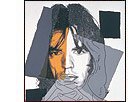
And Warhol's images of Mick Jagger, with their swathes of collage and color and hand-drawn lines that override parts of the silkscreened photograph...well, I found those images quite compelling...and I'm not even a Rolling Stones fan.
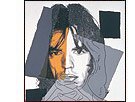
The original Jagger photographs were Warhol's own, but many of the images he used for his silkscreens were simply lifted from the public sphere and reworked. He culled stills from films and took photos from newspapers, magazines and press kits to use as the basis of his artwork. Today, if he copied those same images online, it would be called theft and he'd be fighting copyright infringement lawsuits instead of creating art.

For example, how is "The Grey Album" really that different from Warhol's Marilyn and Mao series? DJ Danger Mouse's 2004 album, which mixed raps from Jay-Z's "The Black Album" with iconic rifs from The Beatles' "White Album," was ranked as best album of the year by Entertainment Weekly. In both cases, the artists took existing materials and transformed them into something new. But Danger Mouse was called a bootlegger and hit with "cease and desist" orders, while (to my knowledge) Warhol was not.

In his AEJMC keynote, "Is Writing Allowed?", Lessig spoke of the flowering of digital and online creativity...of how the Web and digital media are fostering creativity among regular folks, not just artists and movie directors with Hollywood budgets. He spoke of the Web as a disruptive technology, one that's undermining the existing "Read Only" (RO) media and entertainment industry.

The Web and digital media promise to let the control of our culture pass from the tight fists of government and industries into the open hands of the rest of us. It promises to turn our world into a "Read/Write" (R/W) culture, Lessig said, where we can all create, share and consume media products.

One of Lessig's more entertaining examples: the Bush-Blair Love Song, an inspired bit of video commentary that mixes news clips and pop music.

Blogs, on the other hand, draw upon an older tradition: text. In blogs, he noted, the remix of text is free -- no permission is required. It's unregulated, and it's flourishing.

While some people say that most blogs are crap, Lessig said the real value of blogs is that millions of people regularly sit down and their ideas into their own words...and onto the net.

"I believe in copyright," Lessig said, but we forget that the original purpose of copyright law was to provide incentives to create and "permit artists to be independent of patrons." It was not to provide perpetual income for heirs and corporations.

But industry-sponsored "net neutrality" and "broadcast treaty" legislation, along with draconian enforcement of the Digital Millennium Copyright law (with almost no allowances for "fair use"), are threatening to blight that budding digital creativity.

If we continue to let our representatives legislate the Internet to death, and lacerate fair usage, we will end up making the Web safe for commercial speech and little else. And that would be a sad end for such a promising new medium.

Monday, August 21, 2006

New class - Journalism 163

Steve Sloan and I visited this afternoon about Journalism 163, a revised JMC class that will focus on using Web 2.0 technologies and multimedia in journalism and media-related fields. This hands-on class will meet Tuesdays at 6 p.m. in DBH 226 (I was told we may have to meet in DBH 224 for the first session, but it's next door so we'll be easy to find).

Steve recorded our discussion and posted it as a podcast at his SJSU Tech on a Mission blog. Here's the direct link to his podcast: http://www.edupodder.com/podcast/163_intro.mp3

Steve has also set up a class blog for J163 on Wordpress (we thought we'd branch out and try some new blog software). You can find it at: http://jmc163.wordpress.com/

Although Steve is the official instructor for this class, I'm tagging along as team-teacher because I think it looks like a lot of fun...and because I'd like teach this class next semester when JMC begins offering multiple sections of it. So if you can't fit it into your schedule this fall, sign up for the spring semester.

Saturday, August 12, 2006

Just for fun...headline mania

A friend e-mailed these to me, with the question: "Doesn't anyone proofread anymore???" (Good question. I sometimes wonder that myself.) I don't know if these headlines are real, but they made me laugh so I'm passing them on.

THE YEAR'S BEST [actual] HEADLINES OF 2005:

Something Went Wrong in Jet Crash, Expert Says
[No, really?]

Police Begin Campaign to Run Down Jaywalkers
[That'll stop 'em. ]

Panda Mating Fails; Veterinarian Takes Over
[What a guy!]

Miners Refuse to Work after Death
[Good-for-nothing lazy so-and-sos!]

Juvenile Court to Try Shooting Defendant
[See if that works any better than a fair trial!]

War Dims Hope for Peace
[I can see where it might have that effect!]

If Strike Isn't Settled Quickly, It May Last Awhile
[You think?]

Enfield (London) Couple Slain; Police Suspect Homicide
[They may be on to something!]

Red Tape Holds Up New Bridges!
[You mean there's something stronger than duct tape?]

New Study of Obesity Looks for Larger Test Group
[Weren't they fat enough?!]

Kids Make Nutritious Snacks
[Taste like chicken?]

Local High School Dropouts Cut In Half
[Chainsaw Massacre all over again!]

Hospitals are Sued by 7 Foot Doctors
[Boy, are they tall!]

...And the winner is:
Typhoon Rips Through Cemetery; Hundreds Dead

Fun at ZeroOne artfest

I had fun wandering around downtown San Jose with a friend yesterday, looking at some of the ZeroOne ArtFest exhibits. Some of my favorites included...

...the synchronized dancing forks at the "picnic in the park" (a.k.a. the LiveForm:Telekinetics) exhibit.

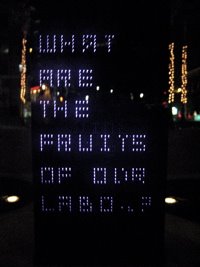
...the infrared monolith (a.k.a. the Screens Exposing Employed Narratives exhibit, at right), where San Jose residents' responses to the question "what is the fruit of your labor?" could only be seen through a digital camera or other "digital capture device."

...the ankle-high patterns of motion and color created by the "400 radio networked, solar powered, self sustainable intelligent analogue pixels" of Ping Genius Loci.

...the digital memories chamber (a.k.a the 'Mission Eternity' exhibit, at left), where you are surrounded by walls of digital images so enlarged and pixelated that they're almost past seeing (a digital camera helps bring these back into focus too).

...and, finally, the images projected onto the facade of the city hall rotunda were just fabulous. This exhibit is titled "Digital Kakejiku," which we are told can be translated as "a moving digital-hanging scroll." Mostly, it was just beautiful...an interplay of slowing changing colors and patterns on the glass and metal framing of the dome. It was amazing to see dozens of people hanging around the city hall courtyard so late at night just to watch the show...like watching fireworks, without the noise.

Thursday, August 10, 2006

The one where I get interviewed at BlogHer

While I was at the BlogHer conference last week, dangling my feet in the hotel pool after hobnobbing during the welcome reception, I was approached by a man with a video camera.

It was Brian Shields, online news manager at KRON4, who was covering the conference and interviewing some of the women of BlogHer...including me!

On a web page titled "The People of BlogHer 2006," he's posted links to interviews with about a dozen BlogHer attendees as well as other stories on the conference. Scroll down the section labeled "Meet the Bloggers Part 1" and you'll find his interview with me...it's just a little ways below his interview with Arianna Huffington. How cool is that!

Tuesday, August 08, 2006

Convergence...schmergence!

An article by David Hazinski in the August issue of the Convergence Newsletter, published by the University of South Carolina, suggests we should "Emerge, Don’t Converge."

Hazinski, who teaches broadcast news at Grady College, University of Georgia, points out that "while both print and broadcast gain advantages from Web-based expansion, broadcasters really get little out of a marriage with print...so it is basically a one-way street, not a partnership."

While a broadcast story can easily be made into a print, Web or radio story, he notes the reverse doesn't hold true for Web and print stories. He continues:
The issue isn’t “print and broadcast and the Web,” the issue is the Web or, more specifically, Internet-based distribution. Print and broadcast are both rapidly losing audience to online journalism. Dozens of studies say this isn’t just about distribution but a migration to a different kind of journalism, one that addresses smaller, more discreet rather than mass audiences. Convergence doesn’t address that trend.
It's hard for us old-schoolers to let go of what we know, but new mediums require new approaches...and the web is a new medium. What the web is not is a combination of all our existing mediums, wrapped into one neat little package. In fact, if there's one thing the web is not, it's a neat little package. The web is messy...like the world.

Friday, July 28, 2006

Blogher: Thoughts on the journalism's future

During a podcasting "how to" session led by Susan Kitchens, who blogs at 2020Hindsight.org, I recorded a short interview with San Jose Mercury News reporter Elise Ackerman.

Here's a link to my first podcast, a seven-minute discussion of the future of journalism with Elise Ackerman.

Making blogs more accessible

At this morning's "Primp Your Blog" session at BlogHer, presenter Skye Kilean spoke about ways to make your blog more accessible to users with disabilities. Kilean writes the Flooded Lizard Kingdom blog. She had some good info, especially for those of us in education.

Kilean described her presentation as "how we add 'wheelchair ramps' to our blogs." Here are some of her suggestions:

Using text, links, colors: avoid uninformative links (such as click here, click on this, etc.). It's better to use a bigger click target (that is, more words, especially descriptive words such as "story on endangered bats"). Links that automatically open a new window can be disconcerting to visually impaired users. Make sure links change color when once they've been clicked so people can keep track of what they've already viewed; also remember some people are colorblind so use other cues, like boldface not just color change, to indicate visited links.

Images: Label photos so visually impaired people get information on key images they can't see. Use brief informative text to label images; remember, screenreaders read the "alt" label, but don't always read the title info. To make a screen reader skip a non-vital image, use alt=_ (leaving a space "_" tells the screenreader to skip this image). Blogger.com includes an "alt" area to describe pictures; edit them in the "edit html" tab.

Spam: Anti-spam measures to stop spam comments can make things difficult for people with visual impairments. Blogger has recently added an audio option for this.

Template-related stuff: Put sidebar on right so visually impaired people get your blog content read to them first, not your sidebar info. Put text size in percentages (Blogger already does this), not specific point sizes, for those who need larger text sizes.

For further information, Kilean recommends Bulletproof Web Design, a book by Dan Cederholm. She has also posted this information and more on her blog, with links to good and bad examples and additional resources.