Sunday, June 18, 2006

Delusions of privacy

"All good things must come to an end," notes an editorial in today's New York Times, "including the chance to post lascivious photographs and diary entries on the Internet without repercussions."

Reflecting on recent reports that many companies have gone from "Googling" their job applicants to checking in social media sites like Facebook and MySpace, the NYT editorialist wrote:

A recent survey found that more than a third of large American companies read their employees' outbound e-mail, and just under a third fired someone as a result. We are only just beginning to wake up to the wider ramifications of the Internet on the personal and the confidential. In the meantime, don't leave a digital trail. That photograph from your friend's party could be more than just embarrassing. It might cost you your dream job.

This particularly struck home to me after running across a post on Weblogg-ed yesterday on "Adults and MySpace" while browsing through some of the blogs linked to the BlogHer site. In that post, Will Richardson talked about how hypocritical it is for us adults to get our knickers in twist over what young people are posting on MySpace when we know they're being exposed daily to ads, videos, films and TV shows that are full of bad behavior, sex and violence.

To illustrate his point, Richardson linked to an explicit advertisement and to a MySpace page that curled my hair (so maybe I'm easily shocked), and wrote:

...repeat those images about 500,000 times until (kids) get old enough to put up a MySpace site and watch what happens.

Some youthful indiscretions can be overlooked (hey, our president admits to "youthful indiscretions" well into his 30s), but it's harder when they can be Googled indefinitely on the web.

Wednesday, June 14, 2006

Web politics

Is the internet going to do for Democrats and other progressives what talk radio has done for the Republican Right? That's the idea behind an commentary on Daily Kos's convention in today's NYT. Here's an excerpt:

There are some cultural reasons why Democrats may be more attracted to the Internet. Democrats, as a group, may have warmer feelings about science and technology, or perhaps they are attracted to the decentralized, anti-authoritarian nature of blogs and e-mail (the exact opposite of a show like Rush Limbaugh's, where the host speaks and the "dittoheads" take it all in).

Makes sense to me.

Tuesday, June 13, 2006

The web journalism we've been hoping for?

Are we finally getting a glimpse of journalism's future?

Award-winning business journalist Christopher Carey is leaving the St. Louis Post-Dispatch to start a new investigative business journalism site, Sharesleuth.com, devoted to exposing stock fraud and corporate malfeasance.

The venture is being backed financially by Dallas Mavericks owner Mark Cuban, a billionaire entrepreneur whose current holdings include HDNet, HDNet Films, Magnolia Pictures, 2929 Productions and the Landmark Theatres chain.

It sounds promising. I've been wondering how investigative journalism could survive in an era when the mainstream media seem cowed by the Bush administration and hamstrung by the financial interests of their corporate owners. Perhaps enterprising reporters like Carey and "investment angels" like Cuban will help create a new model of journalism.

As reported in Talking Biz News and in Romanesko's PoynterOnline blog, Carey's blog-style news site will spotlight "questionable companies and activities, and dig deeply into the people and tales behind them." Sharesleuth.com will take a multimedia approach, using the Web and Cuban’s television network and movie-production capabilities.

I'm hot again!

After years of being ignored by marketers, I just found out I'm hot again. And, no, it's not another hot flash.

According to a recent NYT article, over-the-hill consumers like me are a hot growth market for internet sales.

That shouldn't come as a surprise. The article cites U.S. Census Bureau figures showing those of us who are over 50 now make up 40 percent of the U.S. population, hold 75 percent of the nation's financial assets, and account for 55 percent of all consumer spending. But marketers still tend to focus on the 18-to-34-year-old market.

"A lot of companies have an antiquated way of looking at older people, which makes little sense when you look at how much more disposable income they have now," said Heather Dougherty, an analyst with Nielsen/NetRatings.

The article also quotes Howard Byck, vice president of business development for AARP Services (no, I haven't joined yet), who said, "...In many ways marketers have taken the 50-plus market for granted. The reality is that you can't do that anymore."

I can't wait to be wooed again!


Monday, June 12, 2006

A word to the wise

Be careful what you post. It could come back to haunt you.

According to a recent NYT article, more and more companies aren't just "googling" their job candidates, they're also checking out social networking sites like MySpace and Friendster:
Many companies that recruit on college campuses have been using search engines like Google and Yahoo to conduct background checks on seniors looking for their first job. But now, college career counselors and other experts say, some recruiters are looking up applicants on social networking sites like Facebook, MySpace, Xanga and Friendster, where college students often post risqué or teasing photographs and provocative comments about drinking, recreational drug use and sexual exploits in what some mistakenly believe is relative privacy.

When viewed by corporate recruiters or admissions officials at graduate and professional schools, such pages can make students look immature and unprofessional, at best.

Remember, the web is not a private place.

Sunday, June 11, 2006

Microsoft's loss is SV's gain

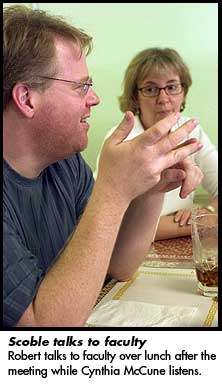
It's only appropriate that the news broke in blogs. Microsoft is losing The Scobleizer, a.k.a. blogger Robert Scoble, a JMC alum who's returning to Silicon Valley for a podcasting gig.

As reported Saturday in blogs like TechCrunch, and Sunday in a Reuters story in the WashingtonPost.com (datelined Monday), Scoble plans to join PodTech.net, a Menlo Park, Calif., start-up that has begun podcasting video interviews of "technology industry luminaries." He will be vice president of content, in charge of creating shows.

Scoble helped bring blogging into the mainstream...and into the PR/marketing mix of a growing number of organizations. Maybe he'll do the same for podcasting.

In the Reuters article, Scoble offered some advice to other corporate bloggers who wish to keep their day jobs:
"Understand your company's culture before you start mouthing off. When you start breaking the rules, you better know you are breaking the rules."
Sound advice.

Sunday, May 28, 2006

First the good news...

I was heartened by the California appeals court ruling this week in a case that pitted bloggers' rights to protect their sources against Apple Computer's right to protect its trade secrets.

I think the appeals court rightly decided that Apple's right to know who leaked product information ends where the First Amendment begins. The appeals court essentially said online and print journalists are equally protected by the First Amendment to the U.S. Constitution, and that Web sites are covered by California's shield law protecting the confidentiality of journalists' sources.

The Electronic Frontier Foundation called it a "huge win." EFF Staff Attorney Kurt Opsahl, who argued the case before the appeals court last month, said the decision was "a victory for the rights of journalists, whether online or offline, and for the public at large."

Blogger Pamela Jones of Groklaw.net, which filed an amicus brief in the case, described it as "a *huge* win!" She added, "Now journalists can feel safe knowing that they can protect their sources’ identity no matter in which medium they choose to disseminate news."

Here's an excerpt from the opinion:
"We can think of no workable test or principle that would distinguish 'legitimate' from 'illegitimate' news. Any attempt by courts to draw such a distinction would imperil a fundamental purpose of the First Amendment" which guarantees freedom of the press."

Link to PDF of the full decision in this case: http://www.eff.org/Censorship/Apple_v_Does/H028579.pdf

Now for the bad news...

The Bush administration appears to be misusing the Patriot Act to track the phone calls of journalists who are reporting on its domestic spying program and allegations of secret prisons in Europe, including reporters at ABC News, The New York Times, and The Washington Post.

Under the Patriot Act, the administration can use
a National Security Letter (NSL) to get phone records without having to go through a judge or notify the people involved...which means journalists won't find out about it until it's too late to get an injunction to protect their sources. No more Judith Millers. Why bother to threaten reporters with jail time for not revealing their sources when you can just secretly tap their phones or get their phone records and find out who they've been calling...and who's been calling them.

Remember when we were told domestic spying was just about tracking terrorists?

Writing in his The Online Beat blog, John Nichols of
The Nation said, "If the administration has begun reviewing the telephone calls of reporters not to catch lawbreakers but to prevent revelations of its own lawlessness, then this White House has strayed onto dangerous political turf."

Pointing to President Nixon's enemies list, which included a number of well-known journalists, Nichols noted that "the Bush-Cheney administration would not be the first to go after journalists in order to protect itself from challenges to its authority."

To see what news reporters are saying about the situation, check out Joe Strupp's article in Editor & Publisher.


Tuesday, May 23, 2006

PR template for the Internet age?

As I was cruising Shel Holtz's PR blog this evening, I found a reference to a new "web 2.0" version of the venerable press release.

Developed by Shift Communications, a PR agency with offices in San Francisco and Boston, this "next generation" press release features re-mixable content and background information in a hyperlinked format. Here's how Shift describes it:
"This radically different format is more à la carte menu than standard press release. In a non-linear fashion, it ties together narrative, quotes and various multimedia (RSS, social bookmarking, photos, etc.) on one page. Journalists and bloggers can 're-mix' the elements into the story THEY want to write."
I looked it over and it looks good: clear organization, clean layout, multimedia links. Even better, Shift is making this new press release template available for free as a downloadable PDF, with no strings attached.

However, Holz wonders, "How many traditional PR practitioners are savvy enough about the changes occurring in the media and communication space to even recognize this is a good idea, no less be aware that the Shift template exists?"

I can't do much to reach traditional PR practitioners, but I can get the word out to some of the next generation by posting a link on my PR class web page.


Thursday, May 18, 2006

A Good Day at JMC

Today was one of those days that makes me glad to be a teacher.

My Journalism 61A students came in today for their "final," which entailed revising their features, and then reformatting them, adding some subheads and hyperlinks, and saving them as web pages. They finished up by posting their stories on the 61A student web page. Not bad for an hour and half of work.

We had fun doing it, and there's always such a sense of accomplishment when you get the job done and see your name in print. And I like being able to be able to send everybody off feeling satisfied and happy. Maybe I just like full-circle endings.

As you browse through their stories, be sure to check out Joel Bridgeman's Can SJSU Football Suvive?, Danielle Ferree's Graduating On Time?, Ekene Ikeme's The Full College Experience is Expensive, Drew Nickolson's Skateboarding: A Trip Too Far, and Carl Ponzio's The Price of Four Letters.

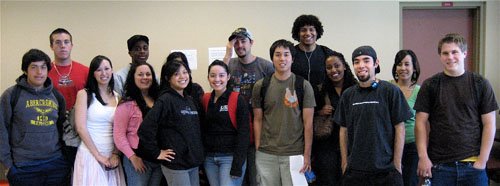
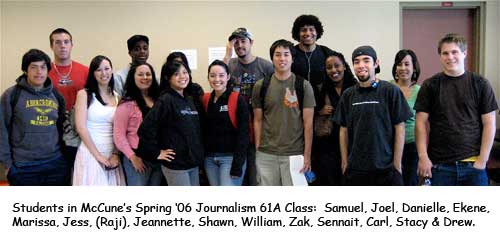
Oh, and here's the class pic. Notice how relieved everyone looks now that the semester is done!


Wednesday, May 17, 2006

Help give JOUR 163 a makeover

Journalism 163 is getting a makeover! This former broadcasting class will debut in the fall as New Media in Journalism...and we'd like your suggestions on what it ought to include.

Interested? Then please join JMC alum and SJSU IT consultant Steve Sloan, who's scheduled to teach one section of the class, and Cynthia McCune, JMC webmaster, for a "geek dinner/meetup" at Tony Soprano's, 87 E. San Fernando Street, at 6 p.m. Tuesday, May 23. Sloan and McCune will spring for the first round of pizzas.

Here's what we want to know: How do you, as students (our customers!) envision such a class, and what would you like to see included in it? We'd like to hear from as many JMC students (and alums!) as possible to reflect the wide range of media interests and levels of tech experience in our School. In other words, you don't need to be a geek to come!

Sloan plans to record the conversation and podcast it...the first of what he hopes will be the first of several podcasts on this subject.

Be there or be square!

Monday, May 15, 2006

Some good news for J-school grads

Newspapers may be on the ropes, but J-schools are doing just fine...and so are many new grads. That's the gist of an article in today's New York Times.

This year, the article notes, the nation's journalism schools "will churn out more graduates than ever into a job market that is perhaps more welcoming to entry-level multimedia-taskers than it is to veterans who began their careers hunting and pecking on Olivetti typewriters."

Some estabished J-schools are expanding enrollments and increasing their multimedia offerings; Yale is even starting a new journalism program.

The article says new grads with the right skills are now replacing many old-school reporters. The article quotes Richard J. Roth, senior associate dean of the Medill School of Journalism at Northwestern University, who said:
"They're just buying out the people who are earning at the top and replacing them with people at the bottom, but those people at the bottom know how to put up podcasts and video."

Also quoted was Mike McKean, chairman of Missouri's convergence journalism faculty, who said,
"Things are changing so quickly that it's not so much about learning a particular tool or software. It's more about an attitude of working in teams and producing content for different audiences."
Food for thought.

Friday, April 28, 2006

Podcast advocacy

Spotted an interesting use of podcasting in an advocacy e-mail.

The e-mail, sent by the organization Common Cause, focused on the ups and downs of a lobbying reform bill now being considered by Congress. The bill was unexpectedly pulled from the House floor yesterday after Republicans disagreed over how much reform was actually needed. The bill is expected to be reintroduced next week.

Common Cause, which supports stronger reforms, included this postscript in its e-mail:

P.S. Listen to a podcast from the head of our ethics team, Mike Surrusco, describing what happened in the House yesterday.

A look at the Common Cause blog (yes, they have a blog too) revealed it was the organization's first national podcast. It's short...just a minute or so long...which makes it easy to take a moment and listen to Mike Surrusco's take on the lobbying reform bill.

I think it's a good use of a new medium. Bet we'll be seeing (and hearing) more like this.

Wednesday, April 26, 2006

The other shoe

As JMC Prof. Bill Tillinghast put it in an e-mail this afternoon, "the other shoe has dropped."

The San Jose Mercury News, along with three other major former Knight Ridder newspapers, has been purchased from The McClatchy Co. by the MediaNews Group Inc. and Hearst Corp. for $1 billion in cash. The deal lets McClatchy make a $1 billion dent in the $4.5 billion debt incurred when it purchased Knight Ridder. (Link to McClatchy's news release on the sale.)

MediaNews will get the San Jose Mercury News and Contra Costa Times, and Hearst, which also owns the San Francisco Chronicle, will get the Monterey (Calif.) Herald and the St. Paul Pioneer Press in St. Paul, Minn. According to a story posted today on the MercuryNews.com, MediaNews also is acquiring Knight Ridder's smaller Bay Area publications, such as the Palo Alto Daily News group and the Silicon Valley Community Newspapers.

One of the largest newspaper companies in the United States, the MediaNews Group owns newspapers throughout California, the Rocky Mountain region and the Northeast.

When MediaNews Chief Executive Dean Singleton spoke to the Mercury News staff today, he was joined by Knight Ridder CEO Tony Ridder. According to the MercuryNews.com article, Singleton said:

"While McClatchy may be buying Knight Ridder, we're getting the flagship and the crown jewel of Knight Ridder. I know how much Tony loves this newspaper. We will continue to make him proud as we go forward.''

To complete the complicated deal, the two companies will trade a couple of their current newspapers as well.

Former Mercury News columnist Dan Gillmor, commenting in his blog at backfence.com, called the MediaNews/Hearst deal "a smelly one" that "just reeks of possible collusion in the marketplace."

Advertising trend-setter?

A new online video advertisement is getting a lot of attention. Some ad experts are already calling it a classic. Here's the link to check it out. (Warning, it's addictive!) While you're there, check out ad producer Albino Blacksheep for a blog with links to other online videos and Flash tutorials.

Here's some background information on the ad (and thanks to Bob Rucker for sending this info to me):

The ad was produced for Honda. Everything you see happened in real time, exactly as you see it. The film took 606 takes. Every time something didn't work, they had to set it up all over again.

The film cost $6 million and took three months to complete, including full engineering of the sequence. Since it's two minutes long, every time Honda shells out big bucks every time it airs on British television. However, since it is fast becoming the most downloaded advertisement in Internet history, Honda executives figure the ad will soon pay for itself simply in "free viewings."

Friday, April 14, 2006

Matchmaker, matchmaker, make me a match

Here's an interesting idea...a syndication service that matches bloggers with web sites, including online news sites, that want content. I spotted a link to it on MediaShift, a PBS-affiliated blog by journalist Mark Glaser that looks at "how new media—from weblogs to podcasts to citizen journalism—are changing society and culture."

The syndication service is called BlogBurst. It offers bloggers the opportunity to increase their "visibility, audience reach and traffic," while providing online publishers with access to interesting and timely content in the form of blogs. Publishers listed as currently trying out this service include the San Francisco Chronicle, washingtonpost.com and Gannett. Interesting, eh?

BlogBurst says it is currently looking for blogs that deal with topics such as: travel, women's issues, technology and gadgets, food and entertainment, and local metro areas. It has plans to expand that list.

BlogBurst says it is looking for blogs that offer:
  • Unique perspectives that add a distinctive voice to feature content
  • Topical, vibrant and timely content that complements existing (web) site content
  • Ethical and fair writing that doesn't put the publisher in a compromising position
Sounds a lot like good journalism, doesn't it? Could this be the next wave of freelancing?

And here are some of the things BlogBurst says online publishers don't want: spam, pornography, hate speech, libelous content, material that violates copyrights, excessive errors in spelling and grammar (I wonder how many "excessive" is), or excessive swearing or profanity (ditto).

I think this might be an idea whose time has come. A number of serious bloggers are looking for ways to make blogging pay, while online publishers need a steady source of fresh, topical content. And it's got to be a lot cheaper to syndicate a few bloggers than it is to pay full-time staff to blog, right?

Wednesday, April 05, 2006

Are we safer in the dark?


Concerned about government secrecy, domestic spying and the like? Take a look at this video, produced by openthegovernment.org as part of national "Sunshine Week," held in March.

The goal of Sunshine Week is to "raise awareness of the importance of open government to the public."

Sunshine Week is co-sponsored by the following organizations:

American Association of Law Libraries
American Library Association
American Society of Newspaper Editors / Sunshine Week
Association of Research Libraries
Coalition of Journalists for Open Government
League of Women Voters
National Freedom of Information Coalition
OpenTheGovernment.org
Special Libraries Association

Openthegovernment.org focuses on issues related to: democracy; environment, health and safety; national security; and government accountability. In particular, it has an array of information and resources related to the Freedom of Information Act (FOIA) and the NSA's domestic spying program.

Tuesday, April 04, 2006

Viral attack ads

It looks like Chevrolet's attempt at viral marketing is giving the automaker a headache...and maybe a case of the sniffles too.

As reported by NYTimes.com, Chevrolet introduced a Web site a couple weeks ago that lets visitors "take existing video clips and music, insert their own words and create a customized 30-second commercial for the 2007 Chevrolet Tahoe."

Most likely, the company hoped people would create some fun videos and e-mail them around the Web, "generating interest for the Tahoe through what is known as viral marketing." That part of the plan apparently worked. There was just one problem: the Tahoe videos getting the most attention, and the widest distribution, are ones that diss the SUV.

For example, one ad that shows the Tahoe being driven through a sweeping desert landscape says, "Our planet's oil is almost gone...you don't need G.P.S. to see where this road leads." Another shows the SUV tooling down a country road lined with sunflower fields, jaunty music playing in the background, then white lettering appears on the screen: "$70 to fill up the tank, which will last less than 400 miles. Chevy Tahoe."

Ouch! The law of unintended consequences strikes again.


Monday, April 03, 2006

Who needs ink?

If, like me, you were out of town over spring break and couldn't attend "Who Needs Ink?" the March 30 Commonwealth Club forum on the future of newspapers, you can read JMC grad student Ryan Sholin's blog post on that event or listen to JMC Alum Steve Sloan's 13-minute edupodder podcast on it.

Sloan asked the panelists (including Joan Walsh of Salon.com, Jerry Ceppos and Dan Gillmor of the Center for Citizen Media) how journalism students should respond to a rapidly changing media environment. Here are a couple of excerpts:
"Learn how to be curious, how to think, how to ask good questions," said Gillmor, who advised students not to worry yet about what the medium will be, but to make sure they are "conversant, if not fluent, in different media formats, including audio, video and writing."

"There's always been uncertainty for journalism students," said Walsh, adding, "Go out and make yourself a great storyteller, and the rest will follow."

After the depressing uncertainty of the Knight Ridder buyout, I found their comments moderately encouraging. Maybe you will too.

Spring cleaning at NYT

The NYTimes.com has redesigned its web site, making it more interactive, more multimedia, and easier to navigate. They've also enlarged the page size to "take advantage of the larger monitors now used by the vast majority of our readers" (wish I was one of them).

NYTimes.com soon plans to offer readers a way to a customize their online news by setting up "a personalized page called MyTimes that will let you organize your favorite Web sources of information — from NYTimes.com and elsewhere — and view them at a glance." (Remember how several JMC students at the Jerry Ceppos lectures suggested more newspapers should be doing something like this? Great minds think alike!)

To read all about it, check out the "letter to our readers" from NYTimes.com's Editor-in-Chief Leonard M. Apcar...and let me know what you think. Do you think this redesign means print mediums like the NYT are really starting to "get" the full potential of the web, or do you think it's mostly window dressing?

Monday, March 27, 2006

The kiss of death

Remember how I told you plagiarism was the kiss of death for journalists and other media writers? Well, another plagiarist just bit the dust.

Blogger Ben Domenech was hired by the Washington Post to debut a new right-right political blog, Red America. He started Tuesday; by Friday, he was gone. Obviously, it doesn't take other bloggers long to suss out a plagiarist.

Here's Post Executive Editor Jim Brady's letter to the public about the Domenech's resignation, and here's an interesting salon.com interview with Brady about why the Post didn't figure it out first.

Given how easy it is these days to fact-check things online, it's a bad time to be a plagiarist.

P.S. You might also want to check out Poynter Online blogger Romenesko's take on this and other hot media topics.
UNH Journalism Program Links

The journalism program at the University of New Hampshire, where I got my BS degree way back in the old day, has a "no-frills" page of journalism links and resources for students, with tips on interviewing, finding story ideas, storytelling, and much more. Check it out. It also has a good resources page for journalists.

It's a small world...

As I headed down the escalator toward the baggage claim area in Manchester Airport Saturday evening, a man walking behind me asked, "Do you do a lot of editing?"

Apparently he and his seatmate had seen me grading papers on the plane. I told them I teach journalism and PR writing classes at San Jose State, and, yes, I do a lot of editing.

"Well, you're talking to a couple of ex-newsmen," he said, adding that he'd been an editor at a newspaper in San Diego. The other man, Jerry Ackerman, said he'd been an editor at the Boston Globe.

Hmm, my journalism professor when I attended UNH was a former Boston Globe reporter. Did he happen to know Andrew Merton? He did. In fact, Merton used to work for him.

I hope to catch up with Merton while I'm in New Hampshire this week (I'll need a break from helping clean out my parent's house) and if I do, I'll pass on a hello from Jerry Ackerman.

Monday, March 13, 2006

Out of the frying pan?

What's worse than being put on the auction block in the first place? How about being told you don't make the grade, and you're going to resold to pay the bills.

That's the situation the folks at the San Jose Mercury News found themselves in today. After perhaps feeling some initial relief that McClatchy, the well-regarded owner of the Sacramento Bee and 11 other U.S. dailies, had submitted the winning $6.5 billion bid for the Knight-Ridder newspaper chain, they found out that their new owner plans to reduce his debt load by selling off some of the less promising papers in the K-R chain...and that his list of losers includes the Mercury News.

That leaves them still hanging fire, and more likely to end up with an owner who will "slash and burn" the newsroom in an attempt to cut costs and pull more profits out of the paper.

In a briefing last week to JMC faculty on the impending sale of the K-R chain, Editor-in-Residence Jerry Ceppos voiced some of those kinds of concerns and listed what he considered to be the three most likely outcomes for San Jose and the Mercury News. He didn't envision this one.

But Ceppos did offer one suggestion that now seems prescient. No matter who buys K-R, he said, we should watch for two things: whether journalists end up near the seat of power, and how much debt the buyer must take on to complete the buyout. That's what will determine whether or not the K-R buyout turns out to be good for journalism, he said.

From that perspective, things aren't looking so good for San Jose and the Mercury News.

In an article in today's WSJ, K-R Chairman and CEO Tony Ridder acknowledges that the "uncertainty is not over" for the 12 K-R newspapers that will be resold, "and I regret that very much."

In the same article, McClatchy CEO Gary Pruitt said he did not anticipate having trouble selling those K-R newspapers, and that the proceeds would be used to pay down debt.


Sunday, March 12, 2006

At the end of the tunnel?

While we worry about how new owners could affect the quality of journalism at the Mercury News and other Knight Ridder newspapers, Michael Shapiro offers food for thought in the current cover article of CJR. In it, he tells how one of the top newspapers in the KR chain, the Philadelphia Enquirer, has fared under what KR's managment.

The upshot: it ain't pretty. Here's an excerpt from his article, Looking for Light:
The Inquirer, it was said in a tone used to describe a handsome friend who has not aged well, was not what it was.... No one was suggesting that the Inquirer had become a bad newspaper, far from it. But it had become duller — yet another newspaper whose occasional highs seemed to come at ever longer intervals. That judgment was rendered both from afar and from within the paper’s white tower of a home on North Broad Street.

The Inquirer had gone through three editors in the last six years, had by last summer seen its newsroom staff already reduced since 1999 from 600 to 500, and perhaps saddest of all, had gone from being perhaps the most alluring and electric place in the business to work to yet another newsroom where some young reporters wondered whether they would have been wiser to have gone to law school.

Shapiro, a writer and media critic, teaches at the Graduate School of Journalism at Columbia University.

New student journalism blog

Here's an interesting new blog/website hybrid, the Blue Plate Special, produced by NYU Journalism Prof. Jay Rosen and his Blogging 101 students. Each "edition" mixes blog posts, interviews and informational features on a single subject. They plan to publish this cross between an online magazine and a blog monthly.

Blue Plate Special No. 1 focuses on Newspaper Blogging: State of the Art and asks: "What happens when the people in the newspaper wing of the legacy media start blogging?" It includes a chart the Blue Plate Special team created on the state of blogging at America's 100 biggest newspapers, and a list of the best blogging newspapers in the United States.

I like this concept. What do you think of it?

More on Blogging

I've gotten some mixed feedback from journalism students (some posted, some in class) on my previous post on blogging, where I quoted newspaper executives at the recent Rethinking Journalism Education summit who said they'd give bloggers an edge when it came to hiring.

Some students view blogs as online personal diaries that are of little value to news audiences. Sure, there are lots of "online journals" out there, but many savvy media writers and media organizations are also experimenting with blogs in interesting (and, I would argue, valuable) ways. Here are a few examples:
  • The Editors Weblog, published by the World Editors Forum, offers "editorial solutions for the newspaper renaissance." It covers trends in news reporting, editing and news coverage worldwide.
  • NewMediaMusings, a blog by J.D. Lasica, former editor of the Sacramento Bee and now a writer, blogger, media consultant and director of Ourmedia.org, a grassroots citizen media project.
  • VisualEditors blog, the news editing and design network, offers comments and links to news on the media.
Public relations practioners and marketers are also figuring out the value of blogging. Here are some examples:
  • AdRants, a blog/website that combines commentary on advertising, marketing and media trends with "a pinch of attitude."
  • Church of the Customer blog, an informative (and self-promoting) blog by two marketers, Ben McConnell and Jackie Huba, on the effects of word of mouth on customer loyalty and "customer evangelism."
  • Micropersuasion, a blog by Edelman Senior VP Steve Rubel that "explores how new technologies are transforming marketing, media and public relations."
  • PR meets the WWW, a blog on public relations, communication, and the World Wide Web of new technologies, by Constantin Basturea, founder of NewPR Wiki and co-organizer of Global PR Blog Week.
You might also want to check out this recent PR Week article, Blogging becoming an asset in agency eye, by Keith O'Brien, who notes that PR agencies are hiring top bloggers. Here's an excerpt:
Has blogging changed from a liability to an asset in the PR job market?

During the nascent days of blogging, when both emerging and large corporations were firing staffers for blogging-related offenses, the jury was out on whether blogging was a nefarious habit, to be hidden when applying for jobs, or a positive career move.

The recent ascension of two high-profile bloggers - Steve Rubel, formerly of CooperKatz, and Jeremy Pepper, formerly of his own firm Pop PR, who were hired by Edelman and Weber Shandwick, respectively - suggests the negative valence of blogging has turned positive. Indeed, today's more pressing question isn't whether you can get a job if you blog, but, rather, whether you can get a job without a blog.

Well, the short answer is yes, but it's more complicated than that.... (direct link to the rest of this story)

It's still possible to argue that blogging is just the "fad du jour," but I think it's getting harder. I think blogging is a significant emerging medium. In fact, you could say blogs are to the World Wide Web what cable TV is to television. (Of course, you might argue that blogs are like HGTV and the Oxygen channel, not ESPN, HBO and MTV...and I'd probably agree.)

Let me be clear: this doesn't mean I think everyone should run out and become a blogger. That wouldn't work. My point is that we ignore emerging technologies (and new mediums) at our own peril.

The media world is changing and we've got to change with it...or be left behind.

Saturday, February 25, 2006

Blogging, anyone?

More missives from the Rethinking Journalism Education conference...

If he had two candidates who were equally well qualified, and one of them blogged, Howard Owens said he'd hire the blogger. Why?

"It indicates a passion about the web," said Owens, who is VP/Interactive for The Bakersfield Californian.

Bill Gannon, editorial director and managing editor of Yahoo! News said, "The great thing about blogging is that is reveals talent and passion."

Here are the kinds of candidates Chris Jennewein says he doesn't hire: "It's as if they have a vision of the way things were, not the way they can be."

What he wants is people who are risk-takers, says Jennewein, director of internet operations at the Union-Tribune Publishing Co., San Diego. He reminded educators at the Morro Bay conference that new types of media mean new opportunities for their students.

"Your students have got a great future," Gannon said. "I want you to be as encouraged about the future as we are. I think that the future is indeed incredibly bright."

Friday, February 24, 2006

What Media Employers Want

The Rethinking Journalism Education conference opened with a panel of media executives who told us what they look for in new hires. Here are the panelists and what they had to say:
Jennewein said he's looking for a "converged student" with demonstrated skills in the web medium, with strong writing and video skills, who knows how to tell stories, knows AP style.

Sandra Duerr wants entry-level reporters who can think visually and graphically, who understand how to deliver information, and understand business/economics.

Bill Gannon says critical thinking ability is most important. He notes all applicants to Yahoo's news division must take a copy editing test and a writing test, and be prepared to work in a time-shifting world.

Howard Owens says new journalists need to know how to interview people, gather documents, and structure a story. They need to be smart, honest, resourceful, and have good judgment. They also need to respect citizen journalism and see journalism as a conversation. He emphasizes they also need to respect ethics, because there's no room for dishonesty.

All agreed students need more than one internship to get the experience they need to hit the ground running at their first real media job.

When Dona Nichols of JMC asked what we're not teaching, what qualifications are missing for many entry-level media job candidates. Jennewein said he's looking for candidates who are versatile, risk-taking, and open to the possibilities out there in the media environment.

Owens added, "If students don't have the passion, the qualifications for journalism, encourage them to find another profession."

Salaries for entry-level reporters

Jennewein: multimedia specialists start from upper $20s to low $40s
Duerr: entry-level reporters start at $34,000-35,000
Gannon: news hires start in $40s to $50s..."depends on how bad I want them." Yahoo also offers stock options.
Owens: entry-level programmers and content producers (advertorial) start at $35-40,000 (that's more than entry-level reporters get in the newsroom)

Major Irony Factor

Here we are at Morro Bay for the "Rethinking Journalism Education" conference, focusing on how to prepare journalism students for a world of new media and new technology…and we can't access the web.

I'm told they're going to "turn it on" later in the conference. Apparently there is no free lunch…or free web access.

(Okay, now we're live)

Wednesday, February 22, 2006

Saving newspapers...or the news?

You've heard it before…continuing declines in newspaper readership and big drops in advertising revenues are prompting questions about the future of journalism and mass media.

Former Knight Ridder news executive Jerry Ceppos opened a series of discussion forums with JMC students this week by reciting some of those sorry stats. Then he asked students for their ideas on how best to save the nation's newspapers.

Halfway through the session, one JMC student got to the crux of the problem:
Is our goal here to save the newspaper, or news in general?
"Let's…say we want to save the news, and make good journalism available to people," said Ceppos, who is on campus this week as JMC's editor in residence, speaking in classes and holding discussion sessions on the future of newspapers and the mass media.

A worthy goal. Here are some ideas from the Tuesday morning session:
  • Move 50 percent of news staff to the web, and reorient the newsroom culture to the web
  • Make it more convenient to get the news
  • Ask subscribers about their interests, and give them ways to tailor news content to their interests
  • Add "cheese" to the spinach, to make "good for you" news more palatable to readers

Monday, February 13, 2006

A Note of Optimism

If you're tired of hearing doom and gloom reports about the future of journalism in the digital age, take heart. Maybe it's not as bad as the some of the old fogeys fear.

That's the message of a recent
Hartford Courant article (sorry, it's archived and pay per view) which noted that, in spite of recent newspaper cutbacks and layoffs, j-school applications are up. Indeed, most journalism students seem undaunted by the worries besetting their news industry elders.

In the story, reporter
Joann Klimkiewicz wrote:
Whereas some news folks see the Internet as a foe, the emerging group of journalists see it as a friend. It means they can get the news out quicker than a printing press allows, that their stories will reach wider audiences and, hopefully, have greater impact.
Although the job market can be tough, there are always openings for talented people and there will always be a demand for news stories. What may change, Klimkiewicz said, is how people prefer to get that information. She continued:
And so the tack many [j-school] programs are taking is to get their students proficient across all media. Good journalism is good journalism, no matter the vehicle.

"The most important thing we can teach our students is to be platform-agnostic," says Rich Hanley, graduate program director for Quinnipiac's school of communications. "The more you can learn, the more you can market yourself.

"A story is a story. At heart, you're still a reporter," Hanley says. "Despite the changes in distribution mechanisms, the skills of a reporter are timeless: Report the facts, report the information objectively, and write clearly."
Sounds like good advice.

Saturday, February 11, 2006

Controversial Images

In my newswriting class this week, we talked about the international uproar over the publication of some controversial cartoons depicting the prophet Muhammad. Some students questioned why a newspaper would publish images that so many people would find offensive, comparing it to crying "fire" in a crowded theater. Others defended their publication on the grounds of freedom of speech.

I find it hard to imagine how cartoons, no matter how crude or offensive, could provoke riots and death threats. But then, I never understood how anyone could call for Salman Rushdie's death for writing the Satanic Verses either. Then again, I'm a Unitarian -- even Garrison Keiller makes jokes about us. But can you imagine me putting out a fatwa on him?

When I try to think of similar situations here in the States, the only thing that comes close is the anger over Andres Serrano's "Piss Christ." A recent Frontpagemagazine.com article, "Piss Christ vs. Cartoon Jihad," compares the Christian response to Serrano's photograph to the Muslim response to the cartoons published in the Jyllands-Posten, a Danish newspaper. And in Peaktalk, blogger Pieter Dorsman also compares the two situations. He writes:
...The ability to apply criticism and ridicule are the basic rights of anyone living in a western democracy. As a society we should expect citizens and artists alike to apply a measure of good taste. It is very hard to argue that the Jyllands-Posten's cartoons were offensive, but a case could be made that Serrano's "Piss Christ" was testing the limits of that somewhat arbitrary 'taste measure'. But we didn't kill Serrano, we didn't destroy his career, we didn't ask him for damages and a rectification, no, we debated it and we are still debating it today, twenty years on. That's freedom, that's democracy.

If you'd like to see more of the cartoons for yourself, follow this link or this one.

Wednesday, February 01, 2006

Photoshop Follies?

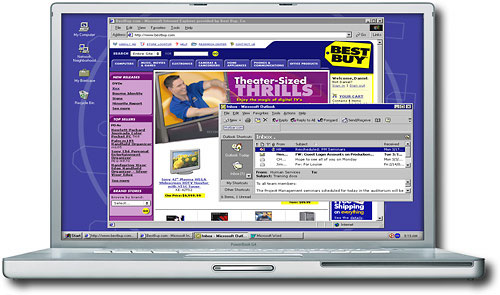
I love it when my students get creative about spotting errors for the "Copy Edit the World" assignment. For example, take a close look at this graphic sent to me by photojournalist and fellow blogger Daniel Sato from my 61A class.

As a writer, I tend to think in terms of typos and AP style errors for this assignment, but, as Sato notes, "designers must also keep a sharp eye out for errors as well!" As evidence, he sent this graphic which seems to show Windows 98 running on a (pre-Intel) Mac.

Looks like somebody went a little Photoshop-happy on this one...and nobody caught it before it went out the door.

Reminds me of a livestock insurance ad I once worked on. The illustration showed a rider on a hunter-jumper (that's a type of horse, for you non-equine-oriented folks) clearing a fence...but the saddle had no girth. Any horse-savvy potential client would have noticed that omission right away, and our client would have lost all credibility. Good thing I caught it first.

Monday, January 30, 2006

Copy Edit the World

Accuracy and attention to detail are important for all kinds of writing, so budding media writers need to hone their proofreading and editing skills. That's why I assign students to "Copy Edit the World," an exercise which offers credit for finding and correcting errors (typos, AP style errors, etc.) in newspapers, magazines, web pages, and other published materials. (Thanks to Frank E. Fee Jr. of UNC-Chapel Hill for this exercise.)

Every semester, I award bonus points to the students who find the most egregious and embarrassing errors. Last fall, Charlene Crooks won my "worst of show" award for a JMC convocation committee fundraising letter, sent to JMC alumni and friends, in which she found not one but two sentence fragments. Ouch!

Fall '05 Copy Edit the World honorable mentions included:
  • a billboard outside a drug store saying "See are new store!" submitted by Kyle Hansen.
  • a postcard advertising "hot imported European beds" (we figured maybe they were stolen), submitted by Victoria Gothot.
  • a tag on a container of lime juice saying it was "natural strenght," submitted by Seychelle Martinez.
For a more recent example, here's a Mercury News article that shows what can happen when when errors go uncaught. Yes, it's called public humiliation.

Sunday, January 15, 2006

Fun at MacWorld '06

Going to MacWorld is just plain fun. Hordes of Mac afficionnados gathered in the bowels of Moscone Center to ooh and ahh over new computers, software, iPod accessories and other swell gadgets.

Here's what I came home with:
  • Cable yoyo, a handy little device for corralling power cords (wish I'd got several)
  • Belkin TuneTies, a silicon figure "8" for stashing iPod earbuds and cables
  • Visual QuickProject books from PeachPit Press on Adobe InDesign (which I use) and Dreamweaver 8 (which I plan to get). Feel free to ask me for a loan.
  • Robin Williams' guide to Mac OS X 10.4 Tiger, and Scott Kelby's book on Tiger Killer Tips (I plan to upgrade soon)
  • A green Chums flip case for my iPod (I like my pink one, but I want better access to the scroll wheel), and a lime green aluminum iPod carrying case (I know, it's overkill...but it was really cute and only $11).
  • Drive Genius, software for maintaining your hard drive
  • A software three-fer: Intego's Net Barrier, VirusBarrier and Personal Back-up (can you tell this is the year I've decided to get serious about computer security and maintenance?)
  • A big pile of handouts on more interesting software, equipment and gadgets

Here's what I coveted:
  • The new MacBook Pro laptop...faster, thinner, lighter...what's not to like?
  • iLife '06...iPhoto has more oomph and Garageband now supports podcasting.
  • SavetheiPods, a clear protective covering for iPods (they ran out...I plan to order it)
  • Browseback, software for saving and searching your browser history, and saving web pages as PDFs for future reference
  • Delicious Library, software for easily cataloging music, software, movie and book collections

Remembering

Requiem
By Wendell Berry


We will see no more
the mown grass fallen behind him...

In the day of his work
when the grace of the world
was upon him, he made his way,
not turning back or looking aside,
light in his stride.

Now may the grace of death
be upon him, his spirit blessed
in deep song of the world
and the stars turning, the seasons
returning, and long rest.


In loving memory of my father, Thomas E. Fernald, who died December 21, during the longest night of the year. He was 86.

Saturday, December 03, 2005

What were they thinking?

Remember the big stink when it came out that the Bush administration had been paying supposedly independent news commentators like Armstrong Williams to talk nice about their education plan? (Need a refresher? See these articles in USA Today, Washington Post and Fox News.)

And remember how the shit hit the fan when it came out that Gov. Arnold Schwarzenegger was putting out VNRs that looked like real news to promote one of his reform programs? (See related article in SF Chronicle and discussion on KPBS.)

Well, apparently the U.S. military has not been paying attention. Otherwise, they would have anticipated the blowback they're now getting about the fake news stories they've been planting in the Iraqi news media.

It seems this "secret" operation, conducted by the military's "information operations task force" with the help of a DC-based consulting firm known as the Lincoln Group, has been going on since early this year. (See the LA Times article that broke this story, and a follow-up by Reuters.)

Many are not pleased. Sen. John Warner, chairman of the Senate Armed Services Committee, quoted in the Washington Post, had this to say:
"I am concerned about any actions that may undermine the credibility of the United States as we help the Iraqi people stand up a democracy," said the committee's chairman, Sen. John Warner, R-Va., adding that he has no information to confirm or deny the reports. "A free and independent press is critical to the functioning of a democracy, and I am concerned about any actions which may erode the independence of the Iraqi media."

Is Warner right to be worried? Judge for yourself. Check out the coverage this story is getting worldwide in news outlets such as Arab News, KurdMedia, News24 (South Africa), and the New Zealand Herald.

Of course, not everyone thinks it's a problem. Take a look at this alternative view by
a retired Air Force brigadier general and professor of defense studies, which appeared as an editorial in the LA Times.

Then check out this angry response on Richard Edelman's blog. (Yes, that Edelman...the
president and CEO of the big public relations firm.)
This is utterly unacceptable behavior. In no way does this describe public relations. It is pay for play and a PR firm based in the US is doing it. Advertising and public relations are not the same thing. We don't do storyboards. We don't buy space. We don't pay journalists to be on our side. We don't fake out media by pretending that we don't know much about our client, working under cover of night. We don't say that there is only one side to a story. If a free media is a central aspect of a democratic society, then we cannot allow our PR industry to impede its development. It is a perversion of our business, an intentional blurring of a clear demarcation between paid and earned media. We should advise our clients, private sector and governmental, that trust is earned through transparency, continuous communication and dialogue.

You might also want to read Falling for Fake News, a good Poynter Online article about the "fake news" trend.

Wednesday, November 30, 2005

Fun with headlines

I always like it when incongruous headlines show up together. Here are some that tickled me today:
Bush's theme on Iraq: victory, not pullout
U.S. military secretly placing favorable stories in Iraq papers
Think one has anything to do with the other? Well then, how about:
Traumatic stress is taking root along Gulf Coast
House budget-cut bill exempts drug makers
(okay, so you need to read the fine print on this one: turns out the exemptions are for mental health drugs, keeping their prices high)
Then, my favorite headline of the day:
Sharp objects might be allowed on planes again

You can play this game too. The only rules are: the headlines have to appear in the same issue of a publication (preferably on the same or facing pages), otherwise the entertaining irony factor is lost. Post your finds here!

P.S. When I read these headlines to my husband: 1) he didn't see the irony, and 2) he didn't think they were at all funny. Maybe you had to be there (in my warped brain, perhaps?) If you agree with Tom, you can tell me that too.

A call to action

If you're worried about the future of newspapers and journalism -- or the future of our democracy without them -- you might want to click over to a recent commentary and call to action by John McManus of gradethenews.org.

In his commentary, McManus writes about the recent threat to San Jose and 32 other cities across America posed by a wealthy Knight Ridder investor's move to force the newspaper chain's sale to increase profits.

Double digit returns apparently aren't good enough for Bruce S. Sherman, CEO and chief investment officer of Private Capital Management (PCM), who stands to reap a personal payout of up to $300 million by selling out the Merc and other papers in the Knight Ridder chain. And since, as McManus notes, PCM is also the largest shareholder in six other U.S. newspaper companies...well, you can see the writing on the wall if this goes through.

Does it make you angry that one greedy profiteer is in a position to ruin the daily news for newspaper readers nationwide? (And that's not counting the audiences of the radio/ TV/cable broadcasters who rip 'n read, or base their stories on what appears in print.)

Wish you could do something about it? Well, here's a letter of protest (and a promise of boycott), drafted by McManus, that you can send to Mr. Sherman. Or, in case you'd rather e-mail him, his address is BSherman@Private-cap.com.

You might also consider sending a letter to the editor at the Mercury News...while you still can.

All things pod

Sometimes, I'm a little slow.

For example, I'd had my iPod for over a year before I finally realized that if I just bought a dock I could plug in some speakers and play all my music without the aid of a CD player (or those cute little white earbud headphones that really don't fit in my ears all that well).

Like I said, sometimes I'm a little slow.

Now, walk past my office and you're likely to catch a waft of music seeping out my door (or blowing out, depending on my mood and whether or not the classroom across the hall is in session).

Mostly I just let it shuffle, so you could hear anything...from John Mayer or Martha's Trouble...to Richard Thompson or Youssou N'Dour...to oldies like Patsy Cline (one of my Mom's favorites; I used to sing along when I was a kid)...or even a bit of choral music from Chanticleer.

But some folks are really cooking. The other day I read how some club DJs are leaving their CDs and such at home and just taking their iPods. (I guess they also figured out about the dock and speakers.) And some people are podcasting -- creating their own digital audio shows and posting them on the web for others to download. What's more, some of them are even making money at it!

I don't know if you saw Podcasting Riches, an article by reporter Michael Bazeley in the Tech Monday section of the Mercury News, but it had a great article about people who are making money off podcasting. He quotes two Midwesterners whose podcast radio show is attracting enough advertisers that least one of them could quit his day job, and two women whose "mommycast" has attracted a $100,000 one-year sponsorship deal from Dixie Paper Products. Amazing!

Which gets me thinking...that maybe the Borg-like Clear Channel will finally meet its match...not in another media behemoth, but in a growing army of colorful and idiosyncratic podcasters. And maybe they'll replace this homogenized, automated, targeted-to-death crap that most radio has become and bring back the real thing...real music, real people, combined in ways that can still surprise and delight.

It really is a brave, new world out there. And for all our worries about radio and newspapers, and the future viability of careers in either, there are also some interesting opportunities cropping up.

So keep your eyes and ears open...and if an opportunity comes along to try something new, grab it! You never know how it might turn out.

Monday, November 28, 2005

Is evangelism the new PR?

Thanks to Prof. Steve Greene for sending me a link to "Spreading the Word," an article on corporate evangelism in the current issue of U.S. News online. They're talking about a new approach to marketing by establishing personal relationships with customers...especially those early adopters who influence others. Evangelism isn't your old-fashioned, one-way, top-down marketing. According to the article:
"It's not about creating a better megaphone," says Bill Hamilton, CEO of TechSmith, a software developer with 100 employees in Okemos, Mich. "To be successful, companies need better conversations with their customers."
The article notes that some companies, like Vespa and Microsoft (see my earlier post on Robert Scoble), are already using bloggers as company evangelists. They see evangelism as "a way of actively creating word-of-mouth advertising or marketing, turning your passionate, influential customers into a volunteer sales force."

Asked what advice he would give to a company like Wal-Mart that has a PR problem, Consultant Ben McConnell, coauthor of Creating Customer Evangelists, offered the following advice:
  • Find customer evangelists through online searches and store surveys.
  • Start blogs and podcasts to humanize the people behind the company's too-opaque walls.
  • Talk openly and frankly about controversial issues like employee health benefits, the company's impact on state Medicare programs, outsourcing, and the hiring of illegal immigrants.
He offered one caveat: PR spinmeisters should be forbidden from being involved.

However, I think that's bogus. As an old PR dog who's learning some new tricks, I don't see why PR folks can't make good evangelists (as long as you remember that there's a difference between PR and "spinning"). Most PR practioners are good at establishing and maintaining relationships, and that's really what we're talking about here.

So, what do you think?

Saturday, November 26, 2005

Spirals & Tipping Points

It's rare to see a full-blown spiral of silence come undone. But that's exactly what happened this week.

After years of being squelched, opponents of the Iraq war found their voice in Rep. John Murtha, D-Pa., an ex-Marine and a Vietnam veteran who proved to be unsmearable. His blunt critique of the Iraq war, and his call for a quick pull-out, provided the tipping point, making it safer for others to wade into the treacherous waters of open criticism of the war.

Thus, the tightly wound spiral of silence on Iraq, which has held public criticism of the war at bay for three years, started to come undone.

So, what's all this about a spiral?

The Spiral of Silence is a theory of media and public opinion developed by in the 1980s by Elisabeth Noelle-Neumann. In essence, it says that most people would rather keep their opinions to themselves than risk being perceived as being out of step with the mainstream, or risk being ostracized for their views. And the fewer contrary views are heard, the more people perceive themselves to be in the minority…and the fewer of them are willing to speak up. Thus, the spiral of silence tightens.

Of course, spirals of silence don't just happen. They usually have some help. In this case, the Bush administration did a masterful job of suggesting -- sometimes subtly, sometimes with all the subtlety of a sledge hammer -- that it was unpatriotic to question the Iraq war or its conduct.

For the most part, it worked. After all, who wants to be accused of hurting troop morale or of aiding and abetting the enemy? So most criticisms of the war were muted or silenced. People with opposing views mostly squelched themselves. And the Bush administration was able to shrug off the criticisms of lonely liberals and people like Cindy Sheehan, the Vacaville woman who lost a son in the war, as being partisan attacks or hysterical outbursts.

Then Murtha spoke out. His comments proved to be the tipping point…and the spiral came tumbling down.

You could watch the administration's desperate attempts to restore the spiral of silence: the initially harsh response from the president, the now-predictable accusations of disloyalty from the vice president, and even name-calling from a junior congresswoman who tried to imply that Murtha was a coward.

This time, though, it didn't work. They'd overplayed their hand. No one bought the image of Murtha as a traitor or a coward. The congresswoman, Rep. Jean Schmidt, apologized; the president, speaking in China, tempered his tone…he respects Murtha, of course, and his right to say what he thinks, he just doesn't agree with him.

Suddenly, it was safe to go in the waters again…and critics of the Iraq war began speaking their minds…and the U.S. Congress began discussing how best to get out of Iraq.

Saturday, November 19, 2005

New JMC Blog

I think I'm getting carried away with this blogging thing...I just started a new JMC blog, The JMC Journal, to take the place of the old "What's New" JMC web page online. It's faster and easier for me to add news on the blog, and that should make it easier to keep everyone up to date. Check it out!

Here are directions on how to subscribe (per JMC grad student Ryan Sholin -- thanks!): just copy this link, http://thejmcjournal.blogspot.com/atom.xml, and paste it into the “Add a feed” box in your in your favorite feed reader software. If you’re using Firefox or Safari, just click on the orange or blue icon that pops up in the URL bar when you’re on the page, and add it to your Bookmarks/Favorites.

Well-Known Blogger Visits JMC


When JMC alum Bob Scoble talked with JMC faculty this week, he didn't pull any punches. The first thing he did was predict that his 11-year-old son would never read a newspaper; instead, he said, he'll get all his news online.

The well-known Microsoft blogger (a.k.a. Scobleizer) talked about the changes he sees coming in the media industry, and how he thinks JMC should change its curriculum to better prepare students for this new media world.

Scoble recommended integrating print design and production with broadcast journalism, and suggested we build a partnership with the computer science department. He also advised us to teach students how to use RSS feeds, news aggregators and other online tools, as well as new advertising technologies.

"The new world is…find some way to build a brand and build traffic," Scoble said. "The business model is changing completely."

So what will J-school students need to know? You'll still need to know how to write and tell stories, and how to take photos or shoot video, Scoble said. But that's no longer enough. The old media already have plenty of experienced hands who have those skills…and they're laying them off.

What new grads will need, Scoble said, are basic computer display skills. You don't have to be a computer programmer or know how to build it, but you do have to understand how things work, where to find it and how to combine it.

"You still need all the same skills to gather news, but you have more tools now. There's a new way to do journalism," he said.

The next generation of journalists (and PR and marketing professionals) are going to need to be able to explain in an animated, graphic way how something happened or how something works. And, Scoble added, the news media is going to need people "who know how to blog and have a conversation" with the public.

If you'd like to read more about Scoble's visit to JMC, check out blog postings by JMC alum Steve Sloan (who also provides an audio link) and JMC grad student Ryan Sholin. And here's a direct link to what Scoble wrote in his blog about his JMC visit.

So, what changes do you think are needed in JMC's curriculum?

Thursday, November 10, 2005

Focus Structure

There's a good example of focus structure in today's Mercury News. Check out the opening paragraphs of Juggling child care providers to see how reporter Michelle Quinn used one mother's experience to personalize and localize a U.S. Census report on the difficulties of arranging child care.

Bad Week for the Mercury News

As I read today's Mercury News, I saw the notice -- the natural consequence of declining advertising revenues and recent layoffs. The MN is stopping publication of The Guide, its Wednesday supplement focusing on neighborhood news. The notice read:
This decision is a reflection of difficult economic challenges faced by the Mercury News and the newspaper industry in general.

Of course, the MN promises to continue to carry many of the local stories that used to appear in The Guide in its daily sections, but it's going to be tough to do with falling ad revenues, fewer pages and fewer reporters.

A premonition of the cutback appeared in Tuesday's business section: an AP article, Newspaper circulation falls 2.6%.
The declines...show an acceleration of a years-long trend of falling circulation at daily newspapers as more people, especially young adults, turn to the Internet for news and as newspapers cut back on less-profitable circulation.

Today's MN business section had more bad news: a recent patent application indicates that Google's next target may be classified advertising.

Google's next gobble: classifed ads? suggests this will put Google in direct competition with eBay and craigslist...but the biggest loser in this scenario would be the daily newspapers, which have been losing classified ad revenues to online companies for some time.

Not exactly a fun time to be in the newspaper industry.

Wednesday, November 02, 2005

Trends & Transitions

The front page of today's Mercury News has a good example of a trend/issue story, Floating an Idea for Energy Needs (if you want to view it online, just be sure to this week or else you'll need to pay to access it). It's about proposals to build new liquid natural gas (LNG) terminals off the California coast.

The story opens with an extended scene-setting lead. Notice the descriptive "telling details" in the first two paragraphs, and how the first four graphs use long, mostly complex sentences. Then comes a change of pace. The writer uses a transition word, "but," and a short sentence to get the reader's attention:
But LNG generates as much emotion as energy.

In this one short sentence, the reporter, Paul Rogers, not only gives readers a "heads up" that he's changing gears, he also introduces them to the conflict that drives this story: the state's need for more sources of energy vs. a local community's protests against these proposals.

Good technique, good story.

Saturday, October 29, 2005

Your Favorite News Sources?

So, where do you go for news? What online news sources do you have bookmarked or selected for your ISP home page? What do you read? What news programs do you regularly listen to or watch?

Has the "grade the news" assignment changed your news habits in any way, or made you more critical of or appreciative of your favorite news sources?

Inquiring minds want to know!

Password Protection Overload

My desire for news is duking it out with my dislike of passwords...and the New York Times is losing.

It happened again tonight. I saw a NYT editorial I wanted to read, clicked on the link, and here's what I got:
Time for the Vice President to Explain Himself
By NICHOLAS D. KRISTOF
Published: October 30, 2005

It's time for Dick Cheney to give the nation "a stiff dose of truth."

To continue reading this article, you must be a subscriber to TimesSelect. Log in now.

Apparently I missed the telltale [TS] beside the title which indicates it's password-protected "TimesSelect" content. Maybe "TS" stands for "tough shit."

I'm tired of having to enter an e-mail address and password to read something online. I now have four email addresses and use multiple passwords (I know, my fault...I've changed ISPs without closing down the old one), so trying to remember which e-mail address and password I used to register for a NYT account can be kind of frustrating. Frankly, I've given up.

I was glad to see I'm not the only one who's sick of this. In a recent blog posting, JMC grad student Ryan Sholin wrote:
As many folks have pointed out, a stable of New York Times columnists have been locked behind a paywall online.

I agree with everyone who thinks this is a load of crap.

Hiding content behind a cash register serves only to further remove the NYT from public discourse. But that’s a given.

Sholin points out that students and faculty can access NYT articles and editorials for free through the Lexis-Nexis database, and directs you to a source that explains how.

Tuesday, October 25, 2005

Entertainment Blues

A recent story by Kim Masters on NPR's Morning Edition explored how increased corporate influence may be hurting the entertainment industry.

As her sources explained how corporate pressure to keep up stock prices and revenues is undermining the creativity and risk-taking of TV and movie studios, I couldn't help but think how the same forces are undermining our news media.

Of course, that's because the entertainment industry has bought up so much of the news media.

Miller's Misplaced Loyalties

Geneva Overholser put her finger on it.

Overholser, a professor at the Missouri School of Journalism (UMC) and a former member of the editorial board at the New York Times, spoke yesterday on The News Hour (PBS) about the NYT's now-public rebuke of reporter Judith Miller. One of the most unsettling aspects of the situation, she said, was that Miller appeared to be giving sources like Scooter Libby, Vice President Dick Cheney's chief of staff, power over what she reported.

"She would have been willing to mislead readers, I think," Overholser said.

That's my impression too. Miller's loyalities seem to lie with the people she's covering, not with the public.

That's not journalism, that's PR. And bad PR at that.

Some Encouraging Words

I came face to face with my own biases the other day.

I had a guest speaker in the classroom -- John McManus, director of gradethenews.org. He was asking students in my newswriting class what they thought of the current direction of the mainstream media, particularly the trend toward more entertainment and 'feel-good' stories, and less actual news.

Honestly, even though this is a journalism class, I thought a lot of my students wouldn't see it as that big of an issue...that only the over-50 crowd like me worries about this kind of thing. But you know what? I was wrong.

Here's what some of them had to say:
"How many times do you need to find out about Brad Pitt," said Gabriel Velez. "The whole celebrity thing...we have so much of it. How much more can you take before it just gets boring?"

"I'd prefer that the news media would give me the news that I need to know...what's going on with our government...avian flu," said Victoria Gothot.

The PR majors were concerned too.
"If it affects the quality of news, PR is affected," said Kao Saechao. "If the news media isn't reaching the public, PR loses a venue."

You know, sometimes it's nice to be wrong.

Saturday, October 22, 2005

Let's call a spade a spade

Note: If you're an ardent Bush supporter, or you think the Iraq War is a truly righteous endeavor, you may want to skip this posting.

When I got an e-mail this week from a colleague touting New York Times reporter Judith Miller's appearance at a recent journalism confab (including a photo of said colleague with Miller), my first reaction was probably not the one he expected. You see, I cringed.

That's because, from the get-go, I've had reservations about the media's adulation of Miller's decision to go to jail to protect her sources. I've had this sneaking suspicion that her decision was, at least in part, a CYA move.

Maybe that's because we now know that much of the "evidence" Miller reported about the threat posed by Iraq in the run-up to the U.S. invasion (remember those WMDs?) was misleading. Wait, let's call a spade a spade: it was a pack of lies.

To my mind, that leaves two choices: either Miller was a gullible sap (and a bad reporter) who got conned by the Bush administration into reporting those lies and exaggerations...or she was a willing participant who happily pushed propaganda. Either way, she doesn't look much like a media hero to me.

Watching all the recent hoopla about Miller, I've been waiting for the other shoe to drop. And now it has. Well, maybe not the whole shoe, maybe just the insole. But whatever it was, it's hit the floor with a thud.

In what an AP story termed a "dramatic e-mail" to NYT staff, Executive Editor Bill Keller said that Miller "appeared to have misled" the newspaper about her dealings with I. Lewis "Scooter" Libby, Vice President Dick Cheney's chief of staff, on these issues, and on her knowledge of Libby's possible role in the "outing" of CIA operative Valerie Plame (the subject of an ongoing federal grand jury investigation, as discussed in this AP article).

However, I think Keller's missing the real point: Miller didn't just mislead the paper and her colleagues; she helped scam the entire nation. If something's printed in the Times, people tend to take it seriously.

I agree with Jack Shafer of Slate. Asserting that "journalistic standards were betrayed at the Times," he wrote:
"…Miller continues to haunt the New York Times two and a half years after her Iraq work was widely discredited, because the paper has yet to document how she botched the story of the decade and catalog the role she played in the current White House imbroglio.

"…The Times won't break free of Miller's malevolent spirit until the paper commissions an exorcism in print, akin to the ones it conducted following the Blair and Lee possessions."

Let the exorcism begin.

This Unfunded Mandate Could Hit You

In response to the growing popularity of VOIP, the federal government is requiring hundreds of universities and libraries to overhaul their Internet computer networks by 2007 to make it easier for law enforcement authorities to monitor e-mail and other online communications to help catch terrorists and other criminals.

One university advocate called it "the mother of all unfunded mandates."

As reported in the New York Times, this FCC order extends the provisions of a 1994 wiretap law that requires telephone carriers to engineer their switching systems at their own cost so that federal agents can easily access them for surveillance purposes.

Universities are protesting that it will cost them at least $7 billion to comply. And that's just for the equipment -- that doesn't count the installation costs or the ongoing costs of hiring and training staff to oversee those systems 24 hours a day, as the law requires.

Even the lowest cost estimates suggest this law will increase annual tuitions at most American universities by some $450.

Students, prepare to write your legislators...or prepare to open your checkbooks!