"Americans increasingly see the war in Iraq as distinct from the fight against terrorism, and nearly half believe President Bush has focused too much on Iraq to the exclusion of other threats, according to the latest New York Times/CBS News poll.Maybe you really can't fool all the people all the time. I was beginning to wonder.
"The poll found that 51 percent of those surveyed saw no link between the war in Iraq and the broader antiterror effort, a jump of 10 percentage points since June. That increase comes despite the regular insistence of Mr. Bush and Congressional Republicans that the two are intertwined and should be seen as complementary elements of a strategy to prevent domestic terrorism."
Wednesday, August 23, 2006
Category of Duh!
A News Flash from today's New York Times:


Tuesday, August 22, 2006
Lessig, Warhol and the Web
I've been thinking about Stanford professor Lawrence Lessig's keynote presentation at the recent AEJMC conference, but I wasn't sure what I wanted to say about it (except that it was great) until I saw the Andy Warhol Dream America exhibit at the San Diego Museum of Art last week.
 That's when it hit me -- if Andy Warhol was alive today, he would be taking images and video clips off the Web and transforming them into little snippets of art and commentary...and probably getting threatened with copyright infringement lawsuits.
Without strong exceptions for fair use in our copyright laws, we would have missed out on some of the most iconic images of our times...Marilyn, Mao, Mick, and the electric chair series.
Honestly, I've never been much of a Warhol fan...the Campbell's Soup thing never struck me as particularly interesting or inspired, and viewing just one of the Marilyn silkscreens left me lukewarm. But it is different seeing the images in person.
 When you see several Marilyn or Mao silkscreens together, and see how the colors change from one silkscreen to the next, but certain facial features remain constant -- with Marilyn, her lips, eyes and eyebrows...with Mao, his lips, eyes and nose -- it is much more evocative and interesting.
And Warhol's images of Mick Jagger, with their swathes of collage and color and hand-drawn lines that override parts of the silkscreened photograph...well, I found those images quite compelling...and I'm not even a Rolling Stones fan.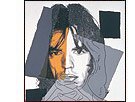
The original Jagger photographs were Warhol's own, but many of the images he used for his silkscreens were simply lifted from the public sphere and reworked. He culled stills from films and took photos from newspapers, magazines and press kits to use as the basis of his artwork. Today, if he copied those same images online, it would be called theft and he'd be fighting copyright infringement lawsuits instead of creating art.
 For example, how is "The Grey Album" really that different from Warhol's Marilyn and Mao series? DJ Danger Mouse's 2004 album, which mixed raps from Jay-Z's "The Black Album" with iconic rifs from The Beatles' "White Album," was ranked as best album of the year by Entertainment Weekly. In both cases, the artists took existing materials and transformed them into something new. But Danger Mouse was called a bootlegger and hit with "cease and desist" orders, while (to my knowledge) Warhol was not.
In his AEJMC keynote, "Is Writing Allowed?", Lessig spoke of the flowering of digital and online creativity...of how the Web and digital media are fostering creativity among regular folks, not just artists and movie directors with Hollywood budgets. He spoke of the Web as a disruptive technology, one that's undermining the existing "Read Only" (RO) media and entertainment industry.
The Web and digital media promise to let the control of our culture pass from the tight fists of government and industries into the open hands of the rest of us. It promises to turn our world into a "Read/Write" (R/W) culture, Lessig said, where we can all create, share and consume media products.
 One of Lessig's more entertaining examples: the Bush-Blair Love Song, an inspired bit of video commentary that mixes news clips and pop music.
Blogs, on the other hand, draw upon an older tradition: text. In blogs, he noted, the remix of text is free -- no permission is required. It's unregulated, and it's flourishing.
While some people say that most blogs are crap, Lessig said the real value of blogs is that millions of people regularly sit down and their ideas into their own words...and onto the net.
"I believe in copyright," Lessig said, but we forget that the original purpose of copyright law was to provide incentives to create and "permit artists to be independent of patrons." It was not to provide perpetual income for heirs and corporations.
But industry-sponsored "net neutrality" and "broadcast treaty" legislation, along with draconian enforcement of the Digital Millennium Copyright law (with almost no allowances for "fair use"), are threatening to blight that budding digital creativity.
If we continue to let our representatives legislate the Internet to death, and lacerate fair usage, we will end up making the Web safe for commercial speech and little else. And that would be a sad end for such a promising new medium.
 That's when it hit me -- if Andy Warhol was alive today, he would be taking images and video clips off the Web and transforming them into little snippets of art and commentary...and probably getting threatened with copyright infringement lawsuits.
Without strong exceptions for fair use in our copyright laws, we would have missed out on some of the most iconic images of our times...Marilyn, Mao, Mick, and the electric chair series.
Honestly, I've never been much of a Warhol fan...the Campbell's Soup thing never struck me as particularly interesting or inspired, and viewing just one of the Marilyn silkscreens left me lukewarm. But it is different seeing the images in person.
 When you see several Marilyn or Mao silkscreens together, and see how the colors change from one silkscreen to the next, but certain facial features remain constant -- with Marilyn, her lips, eyes and eyebrows...with Mao, his lips, eyes and nose -- it is much more evocative and interesting.
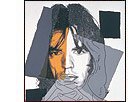
And Warhol's images of Mick Jagger, with their swathes of collage and color and hand-drawn lines that override parts of the silkscreened photograph...well, I found those images quite compelling...and I'm not even a Rolling Stones fan.
The original Jagger photographs were Warhol's own, but many of the images he used for his silkscreens were simply lifted from the public sphere and reworked. He culled stills from films and took photos from newspapers, magazines and press kits to use as the basis of his artwork. Today, if he copied those same images online, it would be called theft and he'd be fighting copyright infringement lawsuits instead of creating art.
 For example, how is "The Grey Album" really that different from Warhol's Marilyn and Mao series? DJ Danger Mouse's 2004 album, which mixed raps from Jay-Z's "The Black Album" with iconic rifs from The Beatles' "White Album," was ranked as best album of the year by Entertainment Weekly. In both cases, the artists took existing materials and transformed them into something new. But Danger Mouse was called a bootlegger and hit with "cease and desist" orders, while (to my knowledge) Warhol was not.
In his AEJMC keynote, "Is Writing Allowed?", Lessig spoke of the flowering of digital and online creativity...of how the Web and digital media are fostering creativity among regular folks, not just artists and movie directors with Hollywood budgets. He spoke of the Web as a disruptive technology, one that's undermining the existing "Read Only" (RO) media and entertainment industry.
The Web and digital media promise to let the control of our culture pass from the tight fists of government and industries into the open hands of the rest of us. It promises to turn our world into a "Read/Write" (R/W) culture, Lessig said, where we can all create, share and consume media products.
 One of Lessig's more entertaining examples: the Bush-Blair Love Song, an inspired bit of video commentary that mixes news clips and pop music.
Blogs, on the other hand, draw upon an older tradition: text. In blogs, he noted, the remix of text is free -- no permission is required. It's unregulated, and it's flourishing.
While some people say that most blogs are crap, Lessig said the real value of blogs is that millions of people regularly sit down and their ideas into their own words...and onto the net.
"I believe in copyright," Lessig said, but we forget that the original purpose of copyright law was to provide incentives to create and "permit artists to be independent of patrons." It was not to provide perpetual income for heirs and corporations.
But industry-sponsored "net neutrality" and "broadcast treaty" legislation, along with draconian enforcement of the Digital Millennium Copyright law (with almost no allowances for "fair use"), are threatening to blight that budding digital creativity.
If we continue to let our representatives legislate the Internet to death, and lacerate fair usage, we will end up making the Web safe for commercial speech and little else. And that would be a sad end for such a promising new medium.
Monday, August 21, 2006
New class - Journalism 163
 Steve Sloan and I visited this afternoon about Journalism 163, a revised JMC class that will focus on using Web 2.0 technologies and multimedia in journalism and media-related fields. This hands-on class will meet Tuesdays at 6 p.m. in DBH 226 (I was told we may have to meet in DBH 224 for the first session, but it's next door so we'll be easy to find).
Steve recorded our discussion and posted it as a podcast at his SJSU Tech on a Mission blog. Here's the direct link to his podcast: http://www.edupodder.com/podcast/163_intro.mp3
Steve has also set up a class blog for J163 on Wordpress (we thought we'd branch out and try some new blog software). You can find it at: http://jmc163.wordpress.com/
Although Steve is the official instructor for this class, I'm tagging along as team-teacher because I think it looks like a lot of fun...and because I'd like teach this class next semester when JMC begins offering multiple sections of it. So if you can't fit it into your schedule this fall, sign up for the spring semester.
Saturday, August 12, 2006
Just for fun...headline mania
A friend e-mailed these to me, with the question: "Doesn't anyone proofread anymore???" (Good question. I sometimes wonder that myself.) I don't know if these headlines are real, but they made me laugh so I'm passing them on.
THE YEAR'S BEST [actual] HEADLINES OF 2005:
Something Went Wrong in Jet Crash, Expert Says
[No, really?]
Police Begin Campaign to Run Down Jaywalkers
[That'll stop 'em. ]
Panda Mating Fails; Veterinarian Takes Over
[What a guy!]
Miners Refuse to Work after Death
[Good-for-nothing lazy so-and-sos!]
Juvenile Court to Try Shooting Defendant
[See if that works any better than a fair trial!]
War Dims Hope for Peace
[I can see where it might have that effect!]
If Strike Isn't Settled Quickly, It May Last Awhile
[You think?]
Enfield (London) Couple Slain; Police Suspect Homicide
[They may be on to something!]
Red Tape Holds Up New Bridges!
[You mean there's something stronger than duct tape?]
New Study of Obesity Looks for Larger Test Group
[Weren't they fat enough?!]
Kids Make Nutritious Snacks
[Taste like chicken?]
Local High School Dropouts Cut In Half
[Chainsaw Massacre all over again!]
Hospitals are Sued by 7 Foot Doctors
[Boy, are they tall!]
...And the winner is:
Typhoon Rips Through Cemetery; Hundreds Dead
THE YEAR'S BEST [actual] HEADLINES OF 2005:
Something Went Wrong in Jet Crash, Expert Says
[No, really?]
Police Begin Campaign to Run Down Jaywalkers
[That'll stop 'em. ]
Panda Mating Fails; Veterinarian Takes Over
[What a guy!]
Miners Refuse to Work after Death
[Good-for-nothing lazy so-and-sos!]
Juvenile Court to Try Shooting Defendant
[See if that works any better than a fair trial!]
War Dims Hope for Peace
[I can see where it might have that effect!]
If Strike Isn't Settled Quickly, It May Last Awhile
[You think?]
Enfield (London) Couple Slain; Police Suspect Homicide
[They may be on to something!]
Red Tape Holds Up New Bridges!
[You mean there's something stronger than duct tape?]
New Study of Obesity Looks for Larger Test Group
[Weren't they fat enough?!]
Kids Make Nutritious Snacks
[Taste like chicken?]
Local High School Dropouts Cut In Half
[Chainsaw Massacre all over again!]
Hospitals are Sued by 7 Foot Doctors
[Boy, are they tall!]
...And the winner is:
Typhoon Rips Through Cemetery; Hundreds Dead
Fun at ZeroOne artfest
I had fun wandering around downtown San Jose with a friend yesterday, looking at some of the ZeroOne ArtFest exhibits. Some of my favorites included...
...the synchronized dancing forks at the "picnic in the park" (a.k.a. the LiveForm:Telekinetics) exhibit.
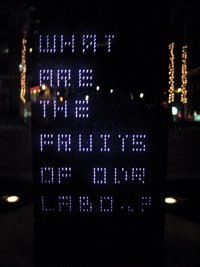
...the infrared monolith (a.k.a. the Screens Exposing Employed Narratives exhibit, at right), where San Jose residents' responses to the question "what is the fruit of your labor?" could only be seen through a digital camera or other "digital capture device."
...the ankle-high patterns of motion and color created by the "400 radio networked, solar powered, self sustainable intelligent analogue pixels" of Ping Genius Loci.

...the digital memories chamber (a.k.a the 'Mission Eternity' exhibit, at left), where you are surrounded by walls of digital images so enlarged and pixelated that they're almost past seeing (a digital camera helps bring these back into focus too).
...and, finally, the images projected onto the facade of the city hall rotunda were just fabulous. This exhibit is titled "Digital Kakejiku," which we are told can be translated as "a moving digital-hanging scroll." Mostly, it was just beautiful...an interplay of slowing changing colors and patterns on the glass and metal framing of the dome. It was amazing to see dozens of people hanging around the city hall courtyard so late at night just to watch the show...like watching fireworks, without the noise.
...the synchronized dancing forks at the "picnic in the park" (a.k.a. the LiveForm:Telekinetics) exhibit.
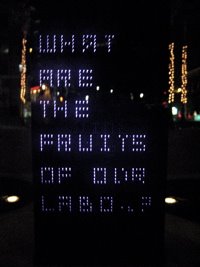
...the infrared monolith (a.k.a. the Screens Exposing Employed Narratives exhibit, at right), where San Jose residents' responses to the question "what is the fruit of your labor?" could only be seen through a digital camera or other "digital capture device."
...the ankle-high patterns of motion and color created by the "400 radio networked, solar powered, self sustainable intelligent analogue pixels" of Ping Genius Loci.

...the digital memories chamber (a.k.a the 'Mission Eternity' exhibit, at left), where you are surrounded by walls of digital images so enlarged and pixelated that they're almost past seeing (a digital camera helps bring these back into focus too).
...and, finally, the images projected onto the facade of the city hall rotunda were just fabulous. This exhibit is titled "Digital Kakejiku," which we are told can be translated as "a moving digital-hanging scroll." Mostly, it was just beautiful...an interplay of slowing changing colors and patterns on the glass and metal framing of the dome. It was amazing to see dozens of people hanging around the city hall courtyard so late at night just to watch the show...like watching fireworks, without the noise.
Thursday, August 10, 2006
The one where I get interviewed at BlogHer
While I was at the BlogHer conference last week, dangling my feet in the hotel pool after hobnobbing during the welcome reception, I was approached by a man with a video camera.
It was Brian Shields, online news manager at KRON4, who was covering the conference and interviewing some of the women of BlogHer...including me!
On a web page titled "The People of BlogHer 2006," he's posted links to interviews with about a dozen BlogHer attendees as well as other stories on the conference. Scroll down the section labeled "Meet the Bloggers Part 1" and you'll find his interview with me...it's just a little ways below his interview with Arianna Huffington. How cool is that!
It was Brian Shields, online news manager at KRON4, who was covering the conference and interviewing some of the women of BlogHer...including me!
On a web page titled "The People of BlogHer 2006," he's posted links to interviews with about a dozen BlogHer attendees as well as other stories on the conference. Scroll down the section labeled "Meet the Bloggers Part 1" and you'll find his interview with me...it's just a little ways below his interview with Arianna Huffington. How cool is that!
Tuesday, August 08, 2006
Convergence...schmergence!
An article by David Hazinski in the August issue of the Convergence Newsletter, published by the University of South Carolina, suggests we should "Emerge, Don’t Converge."
Hazinski, who teaches broadcast news at Grady College, University of Georgia, points out that "while both print and broadcast gain advantages from Web-based expansion, broadcasters really get little out of a marriage with print...so it is basically a one-way street, not a partnership."
While a broadcast story can easily be made into a print, Web or radio story, he notes the reverse doesn't hold true for Web and print stories. He continues:
Hazinski, who teaches broadcast news at Grady College, University of Georgia, points out that "while both print and broadcast gain advantages from Web-based expansion, broadcasters really get little out of a marriage with print...so it is basically a one-way street, not a partnership."
While a broadcast story can easily be made into a print, Web or radio story, he notes the reverse doesn't hold true for Web and print stories. He continues:
The issue isn’t “print and broadcast and the Web,” the issue is the Web or, more specifically, Internet-based distribution. Print and broadcast are both rapidly losing audience to online journalism. Dozens of studies say this isn’t just about distribution but a migration to a different kind of journalism, one that addresses smaller, more discreet rather than mass audiences. Convergence doesn’t address that trend.It's hard for us old-schoolers to let go of what we know, but new mediums require new approaches...and the web is a new medium. What the web is not is a combination of all our existing mediums, wrapped into one neat little package. In fact, if there's one thing the web is not, it's a neat little package. The web is messy...like the world.
Friday, July 28, 2006
Blogher: Thoughts on the journalism's future
 During a podcasting "how to" session led by Susan Kitchens, who blogs at 2020Hindsight.org, I recorded a short interview with San Jose Mercury News reporter Elise Ackerman.
Here's a link to my first podcast, a seven-minute discussion of the future of journalism with Elise Ackerman.
Making blogs more accessible
At this morning's "Primp Your Blog" session at BlogHer, presenter Skye Kilean spoke about ways to make your blog more accessible to users with disabilities. Kilean writes the Flooded Lizard Kingdom blog. She had some good info, especially for those of us in education.
Kilean described her presentation as "how we add 'wheelchair ramps' to our blogs." Here are some of her suggestions:
Using text, links, colors: avoid uninformative links (such as click here, click on this, etc.). It's better to use a bigger click target (that is, more words, especially descriptive words such as "story on endangered bats"). Links that automatically open a new window can be disconcerting to visually impaired users. Make sure links change color when once they've been clicked so people can keep track of what they've already viewed; also remember some people are colorblind so use other cues, like boldface not just color change, to indicate visited links.
Images: Label photos so visually impaired people get information on key images they can't see. Use brief informative text to label images; remember, screenreaders read the "alt" label, but don't always read the title info. To make a screen reader skip a non-vital image, use alt=_ (leaving a space "_" tells the screenreader to skip this image). Blogger.com includes an "alt" area to describe pictures; edit them in the "edit html" tab.
Spam: Anti-spam measures to stop spam comments can make things difficult for people with visual impairments. Blogger has recently added an audio option for this.
Template-related stuff: Put sidebar on right so visually impaired people get your blog content read to them first, not your sidebar info. Put text size in percentages (Blogger already does this), not specific point sizes, for those who need larger text sizes.
For further information, Kilean recommends Bulletproof Web Design, a book by Dan Cederholm. She has also posted this information and more on her blog, with links to good and bad examples and additional resources.
Kilean described her presentation as "how we add 'wheelchair ramps' to our blogs." Here are some of her suggestions:
Using text, links, colors: avoid uninformative links (such as click here, click on this, etc.). It's better to use a bigger click target (that is, more words, especially descriptive words such as "story on endangered bats"). Links that automatically open a new window can be disconcerting to visually impaired users. Make sure links change color when once they've been clicked so people can keep track of what they've already viewed; also remember some people are colorblind so use other cues, like boldface not just color change, to indicate visited links.
Images: Label photos so visually impaired people get information on key images they can't see. Use brief informative text to label images; remember, screenreaders read the "alt" label, but don't always read the title info. To make a screen reader skip a non-vital image, use alt=_ (leaving a space "_" tells the screenreader to skip this image). Blogger.com includes an "alt" area to describe pictures; edit them in the "edit html" tab.
Spam: Anti-spam measures to stop spam comments can make things difficult for people with visual impairments. Blogger has recently added an audio option for this.
Template-related stuff: Put sidebar on right so visually impaired people get your blog content read to them first, not your sidebar info. Put text size in percentages (Blogger already does this), not specific point sizes, for those who need larger text sizes.
For further information, Kilean recommends Bulletproof Web Design, a book by Dan Cederholm. She has also posted this information and more on her blog, with links to good and bad examples and additional resources.
Basking in BlogHer
After weeks without blogging (my summer vacation, I guess), I am back. It's BlogHer time!
The second annual BlogHer conference in San Jose is just now getting underway. And the thing that is so amazing is being surrounded by so many geeky women wielding laptops. Wow! Some men are here too, but they are so outnumbered. It's fun to be in the majority for a change.
The first session I'm attending is called "Primp Your Blog." Let's see if I can find out how to make my basic blogspot baby a little more 'purty ' and user-friendly.
The second annual BlogHer conference in San Jose is just now getting underway. And the thing that is so amazing is being surrounded by so many geeky women wielding laptops. Wow! Some men are here too, but they are so outnumbered. It's fun to be in the majority for a change.
The first session I'm attending is called "Primp Your Blog." Let's see if I can find out how to make my basic blogspot baby a little more 'purty ' and user-friendly.
Saturday, July 15, 2006
The Bees are Back
 The bees are back and buzzing around the eaves of DBH again. The next thing you know, we'll have honey dripping from the upstairs ceilings again too.
Last July, when JMC staff found a puddle of honey in the Update News office, and a telltale ooze of honey from the ceiling, they called the Bee Man, David Williams, for help. I happened to be on campus the day Williams set up his extension ladder and climbed up two stories worth of rungs to spray DBH's eaves and rout the swarming bees.
Here are some shots of the Bee Man at work at DBH, clad in his protective white suit and bee hood:



I was reminded of this today when I read in the Mercury News that the Bee Man had died recently of colon cancer. He was just 58.
Wednesday, June 28, 2006
Losing control?
One of the more interesting blogs I peruse periodically is Micro Persuasion by Steve Rubel of Edelman. He recently spent a day in Paris (geez, life is tough) meeting with European marketers and PR pros who specialize in online communications.
In spite of their cultural differences, he found they all shared one concern: loss of control! Here's an excerpt:
To read the rest, here's the permalink.
In spite of their cultural differences, he found they all shared one concern: loss of control! Here's an excerpt:
Control is the lingua franca that unites us all. Every single person around the table shared an experience of how communicators are concerned about losing control. They simply don't want to give it up. While it was somewhat refreshing to hear that we all are dealing with similar issues, you could also see that the dominoes are starting to fall. We shared lots of inspiring success stories that give hope that bit by bit, we are all changing mindsets together.
I don't blame marketers/PR pros for being afraid to lose control. Nobody wants to. However, the genie is out of the bottle. We can't put it back. We need to look this gorilla in the eye and accept it. We need to embrace this change and do so globally.
Fear of losing control...the need (and the reluctance) to embrace change...where have I heard that before? Wait a minute -- it's the story of my life! On second thought, maybe it's the story of everybody's life. Must mean marketers are people too.
To read the rest, here's the permalink.
Disgraceful? I call it heroic
President Bush called the recent New York Times article that revealed the administration is tracking international financial transactions "disgraceful." I call it heroic.
The Times did what the media is supposed to do -- they told us what our government is doing. That's especially important when our government is secretly doing things that are unethical and illegal...and when there's so much pressure to give the administration our unquestioning support.
As I recall, it wasn't that long ago that Bush got mad when word seeped out that his administration was tapping our international phone calls, without a warrant or judicical oversight. Then, of course, we found out that it wasn't just our international calls they were monitoring, it was domestic calls too. Oh yeah, and later we found out that they're trying to monitor all our e-mails and web browsing trails too.
Given the latest revelation, how much do you wanna bet they're only tracking international financial transactions? Fat chance.
Yeah, I know some consider it unpatriotic to question anything done in the name of the war on terror (and that includes the president, apparently). But we didn't get to be known as "the land of the free and the home of the brave" by acting like a bunch of stupid, compliant sheep. Our nation's founders weren't afraid to question authority, and we shouldn't be either.
Today's NYT editorial page offered a strong defense of the story, noting that this latest revelation about the administration's spying program "looks like part of an alarming pattern." Here's an excerpt from that editorial, "Patriotism and the Press":
The Times did what the media is supposed to do -- they told us what our government is doing. That's especially important when our government is secretly doing things that are unethical and illegal...and when there's so much pressure to give the administration our unquestioning support.
As I recall, it wasn't that long ago that Bush got mad when word seeped out that his administration was tapping our international phone calls, without a warrant or judicical oversight. Then, of course, we found out that it wasn't just our international calls they were monitoring, it was domestic calls too. Oh yeah, and later we found out that they're trying to monitor all our e-mails and web browsing trails too.
Given the latest revelation, how much do you wanna bet they're only tracking international financial transactions? Fat chance.
Yeah, I know some consider it unpatriotic to question anything done in the name of the war on terror (and that includes the president, apparently). But we didn't get to be known as "the land of the free and the home of the brave" by acting like a bunch of stupid, compliant sheep. Our nation's founders weren't afraid to question authority, and we shouldn't be either.
Today's NYT editorial page offered a strong defense of the story, noting that this latest revelation about the administration's spying program "looks like part of an alarming pattern." Here's an excerpt from that editorial, "Patriotism and the Press":
Ever since Sept. 11, the Bush administration has taken the necessity of heightened vigilance against terrorism and turned it into a rationale for an extraordinarily powerful executive branch, exempt from the normal checks and balances of our system of government. It has created powerful new tools of surveillance and refused, almost as a matter of principle, to use normal procedures that would acknowledge that either Congress or the courts have an oversight role.We need to run that risk. Democracy is too important to leave to the politicians....A half-century ago, the country endured a long period of amorphous, global vigilance against an enemy who was suspected of boring from within, and history suggests that under those conditions, it is easy to err on the side of security and secrecy. The free press has a central place in the Constitution because it can provide information the public needs to make things right again. Even if it runs the risk of being labeled unpatriotic in the process.
Monday, June 19, 2006
A road map for PR majors
A senior VP at a major PR agency says it remains "puzzlingly difficult" to find qualified early-career PR candidates.
Writing in his 21st Century Communications blog, Marcel Goldstein of Ogilvy PR Worldwide says university and internship training now gives most young PR professionals a good understanding of communication theory and the mechanics of public relations. But many, he adds, are lacking three key "starting gate" skills.
What's lacking?
To read the rest of Goldstein's comments, here's a link to his blog.
Writing in his 21st Century Communications blog, Marcel Goldstein of Ogilvy PR Worldwide says university and internship training now gives most young PR professionals a good understanding of communication theory and the mechanics of public relations. But many, he adds, are lacking three key "starting gate" skills.
What's lacking?
- Writing skills: "Few read enough and read enough of quality to become good writers."
- Studiousness: "Success in our career requires a thirst for learning."
- Agility: "A new public relations professional must be flexible, adaptable and quick to comprehend the need to change in client and team situations."
To read the rest of Goldstein's comments, here's a link to his blog.
Sunday, June 18, 2006
Delusions of privacy
"All good things must come to an end," notes an editorial in today's New York Times, "including the chance to post lascivious photographs and diary entries on the Internet without repercussions."
Reflecting on recent reports that many companies have gone from "Googling" their job applicants to checking in social media sites like Facebook and MySpace, the NYT editorialist wrote:
Reflecting on recent reports that many companies have gone from "Googling" their job applicants to checking in social media sites like Facebook and MySpace, the NYT editorialist wrote:
A recent survey found that more than a third of large American companies read their employees' outbound e-mail, and just under a third fired someone as a result. We are only just beginning to wake up to the wider ramifications of the Internet on the personal and the confidential. In the meantime, don't leave a digital trail. That photograph from your friend's party could be more than just embarrassing. It might cost you your dream job.
This particularly struck home to me after running across a post on Weblogg-ed yesterday on "Adults and MySpace" while browsing through some of the blogs linked to the BlogHer site. In that post, Will Richardson talked about how hypocritical it is for us adults to get our knickers in twist over what young people are posting on MySpace when we know they're being exposed daily to ads, videos, films and TV shows that are full of bad behavior, sex and violence.
To illustrate his point, Richardson linked to an explicit advertisement and to a MySpace page that curled my hair (so maybe I'm easily shocked), and wrote:
Some youthful indiscretions can be overlooked (hey, our president admits to "youthful indiscretions" well into his 30s), but it's harder when they can be Googled indefinitely on the web....repeat those images about 500,000 times until (kids) get old enough to put up a MySpace site and watch what happens.
Wednesday, June 14, 2006
Web politics
Is the internet going to do for Democrats and other progressives what talk radio has done for the Republican Right? That's the idea behind an commentary on Daily Kos's convention in today's NYT. Here's an excerpt:
There are some cultural reasons why Democrats may be more attracted to the Internet. Democrats, as a group, may have warmer feelings about science and technology, or perhaps they are attracted to the decentralized, anti-authoritarian nature of blogs and e-mail (the exact opposite of a show like Rush Limbaugh's, where the host speaks and the "dittoheads" take it all in).Makes sense to me.
Tuesday, June 13, 2006
The web journalism we've been hoping for?
Are we finally getting a glimpse of journalism's future?
Award-winning business journalist Christopher Carey is leaving the St. Louis Post-Dispatch to start a new investigative business journalism site, Sharesleuth.com, devoted to exposing stock fraud and corporate malfeasance.
 The venture is being backed financially by Dallas Mavericks owner Mark Cuban, a billionaire entrepreneur whose current holdings include HDNet, HDNet Films, Magnolia Pictures, 2929 Productions and the Landmark Theatres chain.
It sounds promising. I've been wondering how investigative journalism could survive in an era when the mainstream media seem cowed by the Bush administration and hamstrung by the financial interests of their corporate owners. Perhaps enterprising reporters like Carey and "investment angels" like Cuban will help create a new model of journalism.
As reported in Talking Biz News and in Romanesko's PoynterOnline blog, Carey's blog-style news site will spotlight "questionable companies and activities, and dig deeply into the people and tales behind them." Sharesleuth.com will take a multimedia approach, using the Web and Cuban’s television network and movie-production capabilities.
I'm hot again!
After years of being ignored by marketers, I just found out I'm hot again. And, no, it's not another hot flash.
According to a recent NYT article, over-the-hill consumers like me are a hot growth market for internet sales.
According to a recent NYT article, over-the-hill consumers like me are a hot growth market for internet sales.
That shouldn't come as a surprise. The article cites U.S. Census Bureau figures showing those of us who are over 50 now make up 40 percent of the U.S. population, hold 75 percent of the nation's financial assets, and account for 55 percent of all consumer spending. But marketers still tend to focus on the 18-to-34-year-old market.
"A lot of companies have an antiquated way of looking at older people, which makes little sense when you look at how much more disposable income they have now," said Heather Dougherty, an analyst with Nielsen/NetRatings.
The article also quotes Howard Byck, vice president of business development for AARP Services (no, I haven't joined yet), who said, "...In many ways marketers have taken the 50-plus market for granted. The reality is that you can't do that anymore."
I can't wait to be wooed again!
Monday, June 12, 2006
A word to the wise
Be careful what you post. It could come back to haunt you.
According to a recent NYT article, more and more companies aren't just "googling" their job candidates, they're also checking out social networking sites like MySpace and Friendster:
According to a recent NYT article, more and more companies aren't just "googling" their job candidates, they're also checking out social networking sites like MySpace and Friendster:
Many companies that recruit on college campuses have been using search engines like Google and Yahoo to conduct background checks on seniors looking for their first job. But now, college career counselors and other experts say, some recruiters are looking up applicants on social networking sites like Facebook, MySpace, Xanga and Friendster, where college students often post risqué or teasing photographs and provocative comments about drinking, recreational drug use and sexual exploits in what some mistakenly believe is relative privacy.When viewed by corporate recruiters or admissions officials at graduate and professional schools, such pages can make students look immature and unprofessional, at best.
Remember, the web is not a private place.
Sunday, June 11, 2006
Microsoft's loss is SV's gain
It's only appropriate that the news broke in blogs. Microsoft is losing The Scobleizer, a.k.a. blogger Robert Scoble, a JMC alum who's returning to Silicon Valley for a podcasting gig.
As reported Saturday in blogs like TechCrunch, and Sunday in a Reuters story in the WashingtonPost.com (datelined Monday), Scoble plans to join PodTech.net, a Menlo Park, Calif., start-up that has begun podcasting video interviews of "technology industry luminaries." He will be vice president of content, in charge of creating shows.
Scoble helped bring blogging into the mainstream...and into the PR/marketing mix of a growing number of organizations. Maybe he'll do the same for podcasting.
In the Reuters article, Scoble offered some advice to other corporate bloggers who wish to keep their day jobs:
As reported Saturday in blogs like TechCrunch, and Sunday in a Reuters story in the WashingtonPost.com (datelined Monday), Scoble plans to join PodTech.net, a Menlo Park, Calif., start-up that has begun podcasting video interviews of "technology industry luminaries." He will be vice president of content, in charge of creating shows.
Scoble helped bring blogging into the mainstream...and into the PR/marketing mix of a growing number of organizations. Maybe he'll do the same for podcasting.
In the Reuters article, Scoble offered some advice to other corporate bloggers who wish to keep their day jobs:
"Understand your company's culture before you start mouthing off. When you start breaking the rules, you better know you are breaking the rules."Sound advice.
Subscribe to:
Posts (Atom)